Showing posts with label map. Show all posts

Old map covers

All these map covers were drawn by Ellis Martin for OS maps published in the 1920s. Click on the map tag for more examples.

'The 1920s and 30s saw the rise of the British tourist industry when, for the first time, ordinary working-class people had enough weekend leisure time to leave their smoky factory towns for a couple of days, and take to the country with its fresh, invigorating air.

It was the beginning of the cycling crazes and the hiking boom, and railway excursions, and - for those who could afford it - days out in the car.

All over the country, map-makers were producing maps of the most attractive areas, and walkers, cyclists and motorists were buying them in their millions. Fierce competition raged between these map-makers until the Ordnance Survey engaged an artist called ELLIS MARTIN to design eye-catching covers for its maps. From then on, the Ordnance Survey led the maket and Martin's superb period designs for OS map covers are now collectors' pieces.
'  J P Browne   Map Cover Art

For other examples of finely drawn commercial art this links to a post I did on cigarette cards.


Minard's Maps

Most people will be familiar with Minard's famous map of Napoleon's Russian campaign.


Here are two more of his maps.

English coal exports 1864


Global migration 1858


A telegram from the War Office

The British War Office used to notify next of kin of a servicemen's death by sending them a telegram.  A uniformed lad on a bike [later a red motor bike] would knock on a door and hand the telegram to a father, mother or wife.


As casualties increased  people began to understand the system and dread the appearance of a telegram delivery boy and a knock on their door.


The Streets They Left Behind web site has produced  a map of the homes of the 9,400 men  who died in World War I who came from the London boroughs of Highbury and Finsbury.  Each red poppy would have meant a knock on the door and a telegram.


The green poppies shows those  casualties who are buried in Islington Cemetery. I suppose those are men who were badly wounded in the war and died back in London.

This page has a link to the above map and also one showing casualties from Toronto.  'By the war’s end in 1918, some neighbourhoods were devastated. Shannon Street, a block running just south of College between Ossington and Dovercourt, lost ten men in the First World War. The Baron family, at 113 Langford Ave. north of Pape and Danforth, lost three sons – 28, 30 and 31 years old. Robert died at Ypres in 1916; Lawson was killed by a shell during a trench raid at Vimy Ridge in 1917; Thomas, gassed in 1915, lingered on to die in Toronto a few weeks before the end of the war.'


There is also an interactive calendar for Toronto's WW1 deaths.


Europe in 1900


So many kingdoms and empires, many of which were swept away by the First World War.  No more Austria-Hungary, no more Ottoman Empire and no more Russian Empire.

Old map covers

All drawn by Ellis Martin, with the exception of the Liverpool map [Arthur Palmer] and the Peak District map [J C T Willis]. All drawn for maps published in the 1920s, with the exception of the Peak District map which was printed in 1936.

Click on the map tag for more examples.


A geographical todo list


Whenever I read or hear of somewhere interesting that I might want to visit I add it to my geographical todo list. This is simply a Google map with push pins. Perhaps a better word for this would be a togo list.

The illustration shows a set of pushpins for Italy. Some of the push pins  have  links to web pages which have more information on the destination. The push pins are organised into layers, so that I can turn on the set for one region or type of destination without turning them all on.

Whenever a location accumulates enough push pins I start thinking about a visit. Before travelling I print out the map and the list of push pins and take these with me. I also use Google maps to plot the route I will be following and calculate distances.

Even if an area does not have enough push pins to justify a special visit I may be able to visit some of the pins en passant as I pass by en route to somewhere else. I recently did this for some travelling I did in the UK.

Old map covers

More map cover art from the 1920s and 1930s.  Click on the map tag for more examples.

Two sinister figures cross Ayr's 'Old Brig'  -  artist Arthur Palmer

artist - Ellis Martin
More after break

The real issue with Google Street View

Google is under attack for its Street View service. Some people have objected to having photographs of themselves or their property appearing online. I do not see the problem. The camera cars only capture what can be seen from the public highway. Also, Google will blur faces or remove images if requested.

It has also emerged that the Street View cars have captured data from unsecured wifi networks as they have driven past.  It appears that the contents of emails, passwords etc may have been collected.  Google have said that this was done in error and I believe them. I cannot see what business reason they could have for deliberately collecting such information.

I think the fuss about these two aspects of Street View is missing the real issue.

The real issue - WiFi location mapping

Google's cars are not just taking photographs. They are also collecting the IP address of every wifi router they pass and recording that address along with its GPS coordinates.

This is for Google's location service. The idea is that phones without GPS [the majority] will be able to find their location by detecting wifi signals. The phone will then check the IP addresses of the wifi routers that are sending out the signal and be told their current location.

If Google take the wifi address of my router and its GPS coordinate and combine it with a postcode directory and mapping data they already have they will know the router is located at 15 High Street, Peckham, London.

If they then combine the address with the UK Electoral Register they will know that John Smith lives at 15 High Street, Peckham, London.

If they then combine the name and address with other socioeconomic databases they will be able to extend my profile with the value of my house and an estimate of my income.

If they can combine my name and address with data on my spending patterns [from my supermarket loyalty card] they will know how I spend my money.

Whenever I go online to a Google site or one that has DoubleClick [a Google subsidiary] or Google Analytics they can collect my routers IP address and link my browsing with my profile.

Goodbye privacy. It will be no use deleting cookies or taking any other steps to protect my privacy. Google will know my True Name and my privacy is screwed.

If people want to worry about Google don't waste time on the Street View nonsense. Worry that Google has mapped every wifi router and thus outed everybody who goes online.

Why are they doing this? To make money. The better the profiles they can create, the more they can charge for really targeted advertising.

Val Gardenia, Dolomites

 
Val Gardenia is very popular with tourists and rather overdeveloped. The best high level walks and via ferratas are the other side of Gruppo Sella Gruppe.

Finding the world's best gelateria with Google Street View

Last year I found this superb ice cream shop in Bologna. The quality and variety of the ice cream was far higher than anything I had previously experienced.


A relative is going to Bologna in July and I suggested they visit this gelateria. The problem was that I could not remember the name of the place, or its precise location. I decided to try and find it with Google Maps.

Step 1 - first did a Google Maps search for gelaterias in Bologna. I knew the one I had visited was in the centre of Bologna, but not precisely where and there are a lot of gelaterias in the centre of Bologna.

Step 2 - the next step was to use Google’s Street View. After a bit of roaming around I found a wall close to the gelateria where we had sat to eat our ice creams.

Comparing the location of the wall in Street View with the map of gelaterias showed that the place I was looking for was


It is very close to the Two Towers.

Unfortunately, the Google camera car had not passed directly by the gelateria so I could not see the precise location in Street View, but it lies within the red square shown on the aerial view.


Added July 2009

 I have just returned form a second visit to Bologna. While there I took the photograph above and had a chance to visit three other superb gelaterias.

Il Gelatauro at Via San Vitale, 98.

Stefino at Via Galliera 49/B

La Sorbeteria at Via Castiglione, 44


Stefino's is close to the city centre. The other two are a little further out. All are extremely good.All three appear to be family owned and all make their own ice cream. In the case of La Sorbeteria you can see into the preparation area and the ice cream making machines.

Some people consider Il Gelatauro supplies the best gelato in the world.  I thought they were all of about the same standard but preferred Il Gelatauro because it is also a cafe and you can sit inside at a table to eat your ice cream in comfort.


See a review of all three gelaterias. It would be nice to have places of similar standard in the UK but , as a general rule, we are not willing to pay for quality.  I do not know of a single place that makes its own ice cream. Everything comes from factories owned by big companies and appears to be made to a price rather than a quality standard.  In the case of ice cream the Italians clearly are willing to pay what is needed to sustain quality producers. In two gelateria I saw locals come in and pay 15-20 euros for a carton filled with a selection of ice creams, obviously for their evening meal.

Map of Leeds and Liverpool Canal route


The map shows the route of the Leeds and Liverpool Canal.

Sections of the route are linked to postings on the Towpath Treks weblog.

Please add a comment to this post if you have any corrections or additions to the route.


View Larger Map

Drones, Google Earth and voyeurs


Try watching this video. It shows somebody launching a camera drone and controlling it using a joystick and virtual reality goggles. As the drone flies along it takes photographs and these are immediately integrated into Google Earth as overlays. There is more information here. The French company that has developed the system has a website which explains how the technology can be used for commercial purposes.


It also occurs to me that this has incredible snooping potential, and if it, or similar, applications became widespread it would pretty much kill outdoor privacy. You might say that Google Earth already offers aerial photographs of your backyard. So they do, but many are very poor resolution, and most are years out of date. What the French company is offering is real time aerial imaging. This is much more invasive.

North Sea to Black Sea Waterway

The completion of the Rhine-Main-Danube Canal in 1992 joined the Rhine-Main and the Danube to create a single waterway from the North Sea to the Black Sea. The waterway is navigable by large barges for its full length, and ocean going ships for part of its length.

CommunityWalk Map - North Sea to Black Sea Waterway

Here is a description of a journey down the waterway.

Map of the Ridgeway

The Ridgeway is a 85 mile long path that runs across the north west Downs and the Chilterns.

CommunityWalk Map - Ridgeway

Click on 'Ridgeway' in the bottom left corner to go to the full map.

Gutenkarte


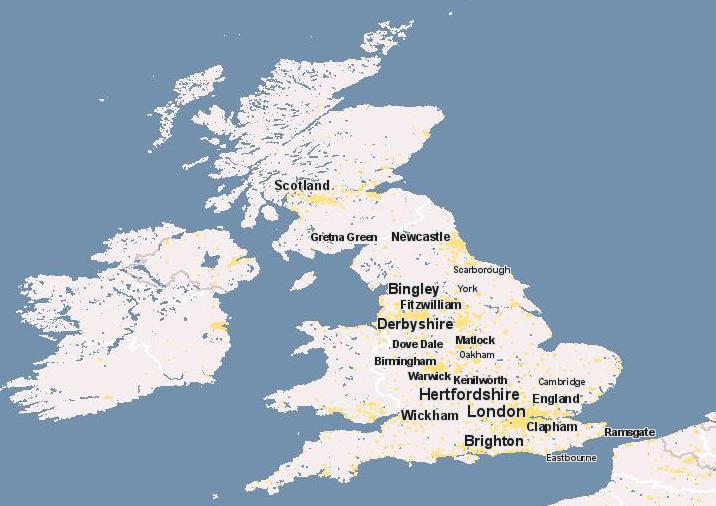
Gutenkarte searches through the text of public domain books from Project Gutenberg and plots on a map any "place names" it thinks it has found. I set it to search Pride and Prejudice. As you can see it successfully plotted the town of [Mr]Bingley. If you click on a name on the map it will display the relevant text from the book.

Wainwright and C2C


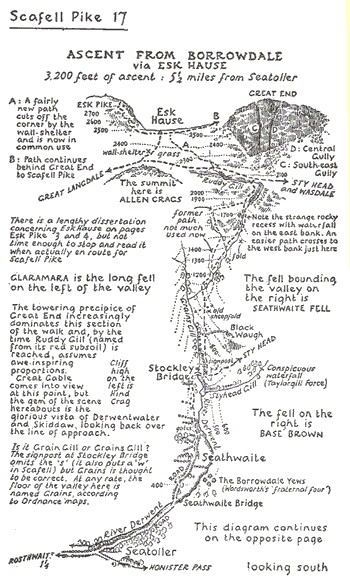
The Lake District is in the North-West of England. It is a very scenic area with lots of fells [hills] that are popular with walkers. Alfred Wainwright wrote a series of beautifully illustrated guides for fell walkers. As you can see from the image above, not only are the maps hand drawn, but the text is hand lettered.

Wainwright died in 1991 and his guides are now being brought up to date by Chris Jesty. ["The routes of paths have changed, lots of walls have fallen down and when Wainwright was travelling to the fells he used public transport so car parks weren't important to him," said Mr Jesty, a former taxi driver who trained in cartography with Ordnance Survey. One relatively brief and simple scramble up Clough Head, which takes only a page in the first new volume, has 30 pieces of "invisible mending", from minor deviations in the route to vanished walls.]

Wainwright also devised a coast to coast [C2C] walk which runs 190 miles across England from St Bees Head to Robin Hoods Bay. I have a copy of Wainwrights book on the C2C, which I bought in 1984, and it was on its 26th printing by then. The Ordinance Survey also publish two maps on the route [Outdoor Leisure maps 33 and 34].

There is also a C2C cycle route of 140 miles which runs from Whitehaven in the Lake District to Newcastle. Sustrans sell a map of the route. BTW Sustrans is a UK organisation which is busy creating a network of footpaths and cycle paths across the UK. If you are planning any long distance walking or cycling in the Uk it is well worth consulting their web site.