Showing posts with label travel. Show all posts

Forgotten history - Scotland's Slate Islands

The photo below shows Easdale Island. It lies off the west coast of Scotland, a few miles south of Oban. It is one of Scotland's slate islands. The ponds which dot the island are actually flooded slate quarries. Some of them are over 80 metres deep. Tens of millions of roofing slates were quarried from these pits and shipped around the world. There are Easdale slates in Australia and New Zealand. The island used to be the centre of the world's slate industry.


 There are four slate islands; Easdale, Seil, Luing and Belnahau. Around 3,000 people lived on the islands when the quarries were working.  All the islands [and their quarries] belonged to the huge Breadalbane estate, owned by the Campbells of Glen Orchy.  The Campbells made a lot of money from the slate quarries but not much of it went to the quarry workers. The Campbells used some of the money to build the huge Taymouth Castle.

The Great Storm

One terrible night in 1881  a storm and a high tide sent water over the island.  Livestock was washed away, gardens destroyed, 40 boats lost and the quarries filled with water. All the  machinery and the workmen's tools had been in the pits and were now underwater. Quarrying  stopped and the islanders were destitute.


Two flooded quarries

Easdale island in the foreground. The village of Ellanabeich [on Seil] in the background.

The workers cottages were built of slate. You can see one below.  The ships that came to take away the slates brought soil in as ballast. This was spread on the island to create gardens where vegetables could be grown to supplement the islanders oats and fish diet.


Some mining continued after the great storm, particularly on the other islands. The photograph below shows some of the slate miners from that period.


By 1930 the demand for slate had shrunk, the Breadalbane estate was bankrupt, people moved away to better paid jobs and slate mining ended. For many years Easdale was almost deserted but now the population has increased to over 60 and new houses are being built. It was a lovely summer day when I visited and the island looked beautiful. From the top of the island's hill there were outstanding views of the Firth of Lorn, the other slate islands and Mull. I would imagine it can be pretty bleak in winter.

The old and new houses of Easdale
 A ferry connects Easdale to the village of  Ellenabeich on Seil. That is it in the photo below.


Easdale's main claim to fame now is that it is the home of the World Stone Skimming Championships. The contest is held in one of the quarries.

 Ellenabeich

There used to be an island called Ellanabeich but the entire centre of the island was  dug out [Ellanabeich slates were particularly fine] and the spoil from the workings used to connect the island of Ellanabeich to the island of Seil.
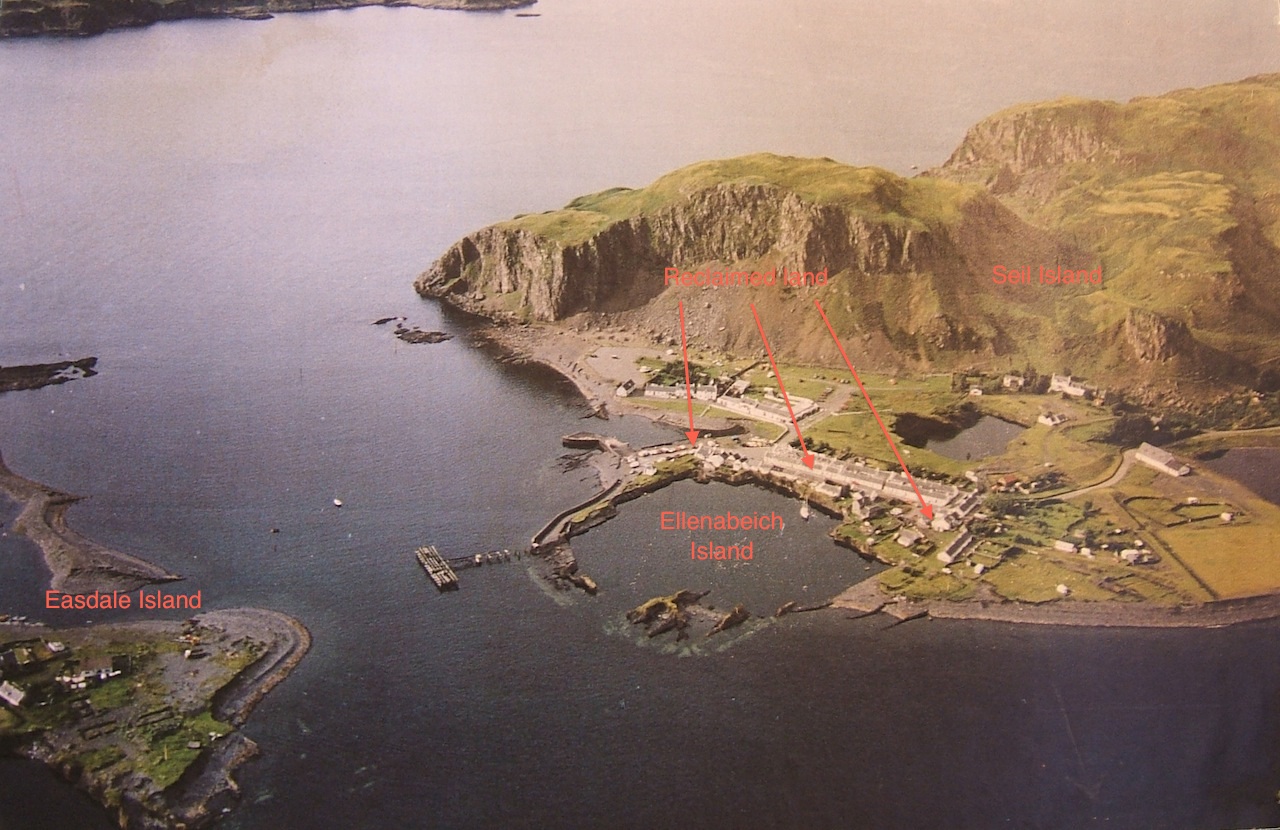

The village of Ellanabeich now stands on that landfill.


A visit to Saltaire Mill


Saltaire is a cotton mill and workers estate near Shipley in Yorkshire, England. It is a UNESCO World Heritage site and an Anchor Point of ERIH [European Route of Industrial Heritage]. The site consists of several large stone built mill buildings, and an estate of brick built workers houses. The site is next to the Leeds and Liverpool Canal. There is a railway station near the mill.


Saltaire was built by Titus Salt who, like Robert Owen of New Lanark, was a philanthropist who spent a lot of time and effort on improving the lot of his workers.

Wikipedia states that, “Salt built neat stone houses (much better than the slums of Bradford), wash-houses with running water, bath-houses, a hospital, as well as an institute for recreation and education, with a library, a reading room, a concert hall, billiard room, science laboratory and gymnasium. The village also provided almshouses, allotments, a park and a boathouse.” This was at a time when housing conditions in the cotton towns were appalling. You can read more about Saltaire at Wikipedia.


Both the mill buildings and the workers houses appear to be in good external condition. The brick built terraced houses are still occupied. They look to have been well built, and must have been excellent housing for the mill workers of the time.


Most of the mill buildings are closed to the public and occupied by Pace, an electronics firm, apart from several floors of one of the mill buildings which have been converted into shops and a cafeteria.


I was disappointed how little effort was being made to help visitors understand the historical significance of the site. For example, it would have been nice of one of the houses had been furnished as it would have been in Salt’s time and opened to visitors, or for visitors to be able to see inside some of the other amenity buildings that Salt built. There is no mill machinery in the buildings that are open to the public, or any effort to illustrate the mill environment.

In fact, there is little historical information or interpretation, apart from a chronology in one small room. The main management objective seems to be to reduce the costs of maintaining the site by letting the buildings for various commercial purposes.

Perhaps this is partly the fault of the local council don’t seem to be making a proper effort to give financial support to Saltaire, or protect the integrity of the site. They don’t appear to have much idea of the responsibilities that go with having a World Heritage site.

I also thought that the historical heritage was not being properly protected. The houses that Salt built are now in private ownership, and some owners have decided to change key external features like doors and windows. Television aerials have been attached to houses and telephone cables are visible. All these changes damage the integrity of the site. In New Lanark, which is the other UK cotton mill that has World Heritage status all the buildings have a common door and window design and paint scheme, and TV aerials and cables are banned.

At the moment there is little point in visiting Saltaire. There is little to see because you will only be able to view the outside of most of the buildings. The one building you can go into is just shops. After you have been you will not have any better understanding of the site’s significance, or how people lived and worked there. This could be a great industrial heritage site, but at the moment it is not worth a visit. The cotton industry started the industrial revolution in Britain and employed millions of people. Its history should be better commemorated than this.

A visit to Crespi d'Adda


Crespi d'Adda is a industrial heritage site a few miles east of Milan, Italy. Like Saltaire in England and New Lanark in Scotland it consists of a cotton mill and workers housing. It was built in 1875 by Cristoforo Benigno Crespi on the banks of the Adda. Like New Lanark [1786] it used hydroelectric power to run the mill machinery. Saltaire [1853] was powered by coal. All three are examples of 'model villages', where a benevolent employer not only provided employment, but good quality housing and other social amenities. All three villages are now designated by UNESCO as World Heritage sites.

All the mills are closed [Crespi in 2004, New Lanark in 1968 and Salt's Mill in 1986] but their housing is still occupied. I have visited New Lanark and Saltaire and had hoped to tour the Crespi d'Adda mills. When we arrived we found that it is possible to wonder around the village, but the factory is only open to pre-arranged tour groups. There is a Visitors Centre but when we visited it was only open in the mornings.  That was a pity because it appeared to have quite a bit of information on the mills and village.


The mill buildings are very ornate and appeared to be in good condition.


New Lanark provided tenement block accommodation fro its workers and Saltaire has rows of terraced houses. Crespi d'Adda had a policy of providing high quality individual houses for its workers. The owners believed it reduced the potential for industrial unrest. You can see the quality of the housing from the photograph below.


Urbino, Gubbio and Assisi

These three Italian hill towns are quite close to each other. We stayed in Urbino and visited the other two on the same day. All have a lot of superb buildings and are well preserved. Assisi is probably the largest and has the best architecture, then Gubbio, and finally Urbino.


In addition to the defensive advantages of building on a hill malaria also played a part. In many countries farmers live on their farms. In parts of Italy farmers live in hill towns and travel out to their fields each day. That is because the plains were once infested with malarial mosquitos and the towns were cooler and had fewer mosquitos.


Urbino


Assisi


The Dukes of these towns had much better taste than the Roman Catholic Church. I was surprised how poor the interiors of the churches were. A lot of money had been spent on the churches but the money had been spent by people who had little sense of artistic merit.


The Ducal Palace in Urbino.


Urbino at night.

Up to Schynige Platte

Schynige Platte is a plateau above the town of Interlaken in Switzerland. It is famous for its wild flowers and views, particularly of Interlaken and its two lakes.


We left our car in the large car park behind Wilderswil station and took the cog railway  to the plateau.  I think this is the only way of getting to the top, apart from walking. A single ticket costs 18 Swiss francs, so it is a pretty expensive trip, though the train journey is an enjoyable experience by itself.  The train stops part way up at Breitlaunen, where there is a hotel/hostel of some kind.

There is also a hotel on the plateau if someone wanted to do a few days of high level walking..


There are several walks around the plateau. There is also a famous walk from Schynige Platte to First, which is above Grindlewald. This is sometimes described as 'the' classic Swiss alpine route. It takes about six hours. Because a railway runs from Grindlewald to Wilderswil you can easily do a round trip involving rail, cable car and Shanks Pony [see the map above].


Schynige Platte offers superb views all around, but particularly of Interlaken and its two lakes.


We made the mistake of walking down from the plateau. It was ok for the first hour, which brought us to  the station at Breitlaunen.

The next two hours to Wilderswil were more trying, particularly because we did not have walking poles with us. The path is good and easy to follow, but three hours downhill was hard on my thigh muscles.

Great Dune of Pilat [Pyla]

The Great Dune of Pilat is in France, just to the south west of Bordeaux.  It is just what the photograph shows. An humongous sand dune standing all along on the coast, near to the mouth of the Bay of Arcachon. I have no idea what unusual natural forces have led to its formation, but it is worth seeing if you are nearby.


After you have slogged up to the top of the dune you can sit and admire the marvelous view. It was a nice day when we were there so it was all very pleasant.


You can see the dune marked on the map below. 


Links to some strange dunes in Japan and Brazil.

Arcachon is a pleasant seaside resort.  They rear oysters in the bay. Some of the oyster fishermen have built houses on the Ile aux Oiseaux [Isle of Birds]. You can see some of these in the final photograph. They are built on piles because the island is under water at high tide.