
Showing posts with label environment. Show all posts
Showing posts with label environment. Show all posts


Wind resources in Europe

Scotland is particularly well placed to generate power from both wind and tide. Scotland's last coal fired power station [Longannet] closed in 2016. Wind is unpredictable and needs new battery technology before it can be fully exploited. Tidal power is predictable but more of an engineering challenge.
Tallwood
On a recent visit to Vancouver I went out to the University of British Columbia [UBC] campus. There is much of interest on the campus, including the Museum of Anthropology, the Nitobe Gardens and the Museum of Biodiversity. See my posts on the first two of these.

This post is about a recently added attraction. The Tallwood student residence. This building is the tallest wooden building in the world with 17 stories and accommodation for 400 students. Instead of using reinforced concrete most of the building is constructed using cross laminated timber [CLT].
CLT is like grown up plywood. It consists of strips of timber glued together to whatever thickness and shape is required. CLT is very strong and rot and fire resistant. Accommodation units were factory built off site and then just slotted into the building.

This video provides a time lapse of the buildings construction.
Using CLT speeds construction and is environmentally superior to concrete. Instead of using a lot of energy to produce cement the CLT building method locks up CO2 for the life of a building.
Canada has a lot of trees and is well equipped to lead in the construction of buildings like Tallwood. The amount of timber used in the construction was replaced in 6 minutes by the normal growth of Canada's forests.
A lot of Canada's cities have housing shortages. The situation in Vancouver is particularly bad. Some government contracts to build a lot of apartment blocks would be a way of developing the country's CLT production and construction industries.
New Zealand is another country with a lot of trees but not enough houses. I wonder if it is looking a CLT construction.
Visiting UBC
There are frequent buses from downtown Vancouver. It is a very attractive campus but also a large one. The Museum of Anthropology [shown as MOA on campus maps] and the Nitobe Gardens are close together on the edge of the campus. Tallwood and the Museum of Biodiversity more central and are fairly close together.

This post is about a recently added attraction. The Tallwood student residence. This building is the tallest wooden building in the world with 17 stories and accommodation for 400 students. Instead of using reinforced concrete most of the building is constructed using cross laminated timber [CLT].
CLT is like grown up plywood. It consists of strips of timber glued together to whatever thickness and shape is required. CLT is very strong and rot and fire resistant. Accommodation units were factory built off site and then just slotted into the building.

This video provides a time lapse of the buildings construction.
Using CLT speeds construction and is environmentally superior to concrete. Instead of using a lot of energy to produce cement the CLT building method locks up CO2 for the life of a building.
Canada has a lot of trees and is well equipped to lead in the construction of buildings like Tallwood. The amount of timber used in the construction was replaced in 6 minutes by the normal growth of Canada's forests.
A lot of Canada's cities have housing shortages. The situation in Vancouver is particularly bad. Some government contracts to build a lot of apartment blocks would be a way of developing the country's CLT production and construction industries.
New Zealand is another country with a lot of trees but not enough houses. I wonder if it is looking a CLT construction.
Visiting UBC
There are frequent buses from downtown Vancouver. It is a very attractive campus but also a large one. The Museum of Anthropology [shown as MOA on campus maps] and the Nitobe Gardens are close together on the edge of the campus. Tallwood and the Museum of Biodiversity more central and are fairly close together.
Bonny Scotland

This is the picture most tourists have of the Scottish countryside. They find it beautiful, but that is because they do not understand what they are seeing.
What they are seeing is a devastated industrial landscape. The bare hills and glens of Scotland are a product of the sheep farming and the sporting industries. Approximately 98% of the natural Scottish forests have been cleared. Neolithic farmers started the tree felling and it has continued to the present day. The bare green hills are now only good for sheep, deer and grouse. There are too many deer in Scotland and deer are very good at preventing forests from regenerating. If neither the sheep farming or shooting industries existed the countryside would look very different.
Sheep farming is not economically viable. Without subsidies farmers would be losing money on every animal they raised. Sporting estates are not much better. When I drive up to Edinburgh I pass through mile after mile of this industrial landscape. A landscape that is full of sheep farms that provide only a subsistence living to their owners.
What needs to happen is for the Scottish Parliament to introduce a scheme to persuade landowners to move away from sheep and grouse farming, and to start reforestation. To start replanting the Great Caledonian Forest that once covered Scotland. Once the forest started to regenerate we could start looking at reintroducing some of the species that have been lost.
A small step towards making this happen is being taken around Loch Katrine with a scheme to plant thousands of acres with broadleaf trees, such as oak, rowan, alder, willow, ash, and aspen. There is so must wasted land in Scotland that we could create a forest covering thousands of square miles. This would not only be a recreational asset for Scots, but also a tourist attraction. It would also do something towards alleviating global warming.
The last straw in fake news
Some people have been getting anxious about the use of plastic straws. They should be banned, they cry.
The media have picked up on this and cited various statistics about the number of plastic straws that are being used.
'Each day, Americans use an estimated 500 million straws. The number has been used to illustrate the scale of the issue and modern society’s reliance on this ubiquitous piece of disposable plastic.
It turns out, however, that the number is imprecise and originates from Milo Cress, a young environmentalist who researched straw usage to come up with the 500 million estimate when he was just nine years old.
As a curious fourth grader who had just started an environmental project to discourage restaurants from providing straws by default, Cress decided to look online to find out how many straws are used each day in the United States. Not being able to find any statistics, he called straw manufacturers directly and estimated the 500 million figure based on numbers they provided him.'
Read more on Tim Newman's blog.
Link
The media have picked up on this and cited various statistics about the number of plastic straws that are being used.
'Each day, Americans use an estimated 500 million straws. The number has been used to illustrate the scale of the issue and modern society’s reliance on this ubiquitous piece of disposable plastic.
It turns out, however, that the number is imprecise and originates from Milo Cress, a young environmentalist who researched straw usage to come up with the 500 million estimate when he was just nine years old.
As a curious fourth grader who had just started an environmental project to discourage restaurants from providing straws by default, Cress decided to look online to find out how many straws are used each day in the United States. Not being able to find any statistics, he called straw manufacturers directly and estimated the 500 million figure based on numbers they provided him.'
Read more on Tim Newman's blog.
Link
Planning for the past
In the 1830s the Swedes discovered that the island of Visingso had ideal conditions for growing oak trees. The Swedish Royal Navy thought it might be a good idea to have a source of oak for building sailing ships and particularly for use as masts and spars.

Over the next ten years some 300,000 oak saplings were planted. To ensure that the oaks grew straight and tall other, faster growing species, such as ash, elm, maple, beech and silver fir were planted between the oaks. If the oak trees wanted light for photosynthesis they had to grow straight.

Today the 900 acre forest has immensely tall and unusually straight trees. Ideal for building Sweden's wooden walls. Unfortunately, oak trees take about 150 years to reach maturity and in that time shipbuilders moved to using iron and then steel for hulls.
In 1670, Louis XIV’s finance minister, Colbert, demonstrated similar foresight and ordered the planting of oak trees to provide masts for the French Navy of 150 years hence. He created the 26,000 acre Forest of Tronçais. As with Visingso the oaks were planted with beeches and larches to encourage them to grow straight, tall, and free of knots.
As with Visingso, by the time they matured they were no longer necessary. Historian Fernand Braudel wrote, “Colbert had thought of everything except the steamship.”
Over the centuries the trees have been used to make charcoal for iron making and other uses. Only 13 ha of Colberts original forest remains and is now protected. The rest of the oak trees in the forest are the product of regeneration.
Now the older oaks of Troncais are used to make high quality casks for the wine trade. Coopers use the most suitable parts of the old oaks and sell their casks to a select number of wine makers.
The Forest of Tronçais is considered by many to be the finest oak forest in Europe.
Other oak forests have been more successful. There are over six million acres of cork oak trees in Southern Europe and North Africa. In Portugal a cork oak cannot be cut down without permission from central government.
The bark of the cork oaks of Portugal is peeled off and used to produce wine bottle stoppers, cork flooring, the cores of cricket balls, badminton shuttlecocks and the handles of fishing rods. Their acorns are used to feeds pigs which are later converted into delicious and very expensive Jamon de Bellota.

On a different time scale, it used to be the custom amongst the English landed class to plant some willow trees when a daughter was born. Willow trees take about twenty years to reach maturity. When the daughter married the trees would be sold to a cricket bat maker to pay for the wedding. A mature willow tree can be sold for about £300 so several would be needed. Link
Some other tales of old trees. Link
Over the next ten years some 300,000 oak saplings were planted. To ensure that the oaks grew straight and tall other, faster growing species, such as ash, elm, maple, beech and silver fir were planted between the oaks. If the oak trees wanted light for photosynthesis they had to grow straight.
Today the 900 acre forest has immensely tall and unusually straight trees. Ideal for building Sweden's wooden walls. Unfortunately, oak trees take about 150 years to reach maturity and in that time shipbuilders moved to using iron and then steel for hulls.
In 1670, Louis XIV’s finance minister, Colbert, demonstrated similar foresight and ordered the planting of oak trees to provide masts for the French Navy of 150 years hence. He created the 26,000 acre Forest of Tronçais. As with Visingso the oaks were planted with beeches and larches to encourage them to grow straight, tall, and free of knots.
As with Visingso, by the time they matured they were no longer necessary. Historian Fernand Braudel wrote, “Colbert had thought of everything except the steamship.”
Over the centuries the trees have been used to make charcoal for iron making and other uses. Only 13 ha of Colberts original forest remains and is now protected. The rest of the oak trees in the forest are the product of regeneration.
Now the older oaks of Troncais are used to make high quality casks for the wine trade. Coopers use the most suitable parts of the old oaks and sell their casks to a select number of wine makers.
The Forest of Tronçais is considered by many to be the finest oak forest in Europe.
Other oak forests have been more successful. There are over six million acres of cork oak trees in Southern Europe and North Africa. In Portugal a cork oak cannot be cut down without permission from central government.
The bark of the cork oaks of Portugal is peeled off and used to produce wine bottle stoppers, cork flooring, the cores of cricket balls, badminton shuttlecocks and the handles of fishing rods. Their acorns are used to feeds pigs which are later converted into delicious and very expensive Jamon de Bellota.

On a different time scale, it used to be the custom amongst the English landed class to plant some willow trees when a daughter was born. Willow trees take about twenty years to reach maturity. When the daughter married the trees would be sold to a cricket bat maker to pay for the wedding. A mature willow tree can be sold for about £300 so several would be needed. Link
Some other tales of old trees. Link
Plastics in the sea - the culprits

According to Britain's Economist magazine about 90 percent of all the plastic that reaches the world's oceans gets washed down just 10 rivers.
These are the Yangtze, the Indus, Yellow River, Hai River, the Nile, the Ganges, Pearl River, Amur River, the Niger, and the Mekong (in that order).
Very little plastic comes from North American, European and other first world countries. They have good water treatment systems.
If we want to reduce the amount of plastic in the oceans we need to put strong pressure on the countries that control the 10 rivers.
In Britain environmentalists have wasted their time on attempts to stop people using plastic straws and disposable coffee cups. Such campaigns are puerile and pointless when the potential benefits are compared to the amount of stuff being but in the oceans by China, India and other major polluters.
Pollution from coal power stations
Which country is producing the most carbon pollution from coal powered electricity generators?
Yes, you have guessed it -it is China. Closely followed by the good old USA.

Blue circles represent the total carbon emissions in millions of tons from coal fired power stations. The outer ring represents a country's total emissions from coal, oil and gas power stations. The white area is therefore the emissions from oil and gas fuelled power generation.
Note that Australia produces more pollution from coal powered stations than the UK, despite the UK having about four times the population.
Yes, you have guessed it -it is China. Closely followed by the good old USA.

Blue circles represent the total carbon emissions in millions of tons from coal fired power stations. The outer ring represents a country's total emissions from coal, oil and gas power stations. The white area is therefore the emissions from oil and gas fuelled power generation.
Note that Australia produces more pollution from coal powered stations than the UK, despite the UK having about four times the population.
Bug Hotel
In a garden in a National Trust property in Derbyshire, England.


A more palatial bug hotel in a public garden in France

A more palatial bug hotel in a public garden in France
The Iron Chink
The Fraser River is the longest river in British Columbia [854 miles] and flows into the sea just south of the city of Vancouver. Every year tens of millions of salmon used to enter the mouth of the Fraser and several canneries were built at at the small port of Steveston to process the catch.

At the turn of the twentieth century, Steveston was the busiest fishing port in the world, with fifteen salmon canneries, six hotels, numerous saloons and gambling dens, and up to fourteen windjammers simultaneously loading canned salmon for world markets. On a Saturday night, 10,000 people thronged the board walks, including Native Indians, Japanese, Chinese, European immigrants, and sailors from the seven seas.
Some of the cannery labour was provided by Chinese workers who had come
to Canada to work on the transcontinental railway and were unemployed
when the railway was finished. At the Gulf of Georgia Cannery three
gangs of thirty men each worked on topping, tailing and gutting the
salmon. Fast work with sharp knives produced a crop of lost fingers.
In 1903, Edmund A. Smith developed a machine that could guts and
clean salmon many times faster than human workers. A good worker could
remove fins, head, tail and innards from about 2,000 fish per 10 hour
day. On the first day the machine cleaned 22,000 fish in nine hours, or
about 40 fish per minute. By 1904, the fish-cleaning machines could
pack an average of 9,000 to 10,000 cases of salmon per day.
Workers laid the salmon one by one on a moving track. Each salmon had its head cut off by a sharp, rotating blade. A workman then pushed each salmon into the butchering machine. The machine quickly pinned the fish and cut off its tail and fins, and opened the belly with a saw. It even cleaned out the blood and guts with brushes. The butchered salmon was then ejected onto a conveyor belt and sent to the washing tables.
Smiths machine became widely know as the “Iron Chink”, because if could perform the work of approximately 50 Chinese salmon butchers. The innovation increased cannery profits but made thousands unemployed.
Of course, the usual tragedy of the commons situation arose and the
salmon were almost wiped out by overfishing. Eventually, all the
canneries closed. Only one remains and that is now a museum.
The museum is is a national heritage site and is well worth visiting. Stevenson is easily reached by a subway and bus ride from central Vancouver.
Thanks to conservation efforts salmon are returning to the Fraser in the tens of millions. A local newspaper reported that ' The Pacific Salmon Commission, which had been anticipating a return of about 12 million pinks, now says an estimated 26 million fish are in the Fraser. Other rivers are experiencing remarkable returns as well.
“The fish poured in here in such numbers that the sea was a sparkling diamond,” said Ken Kirkby, who has been working to restore salmon runs in Nile Creek on Vancouver Island. “You can’t see the bottom of the river for the salmon.”
The increase in salmon numbers may be due to a controversial experiment which dumped100 tonnes of iron sulphate and 20 tonnes of iron oxide some 350 kilometres off the Haida Gwaii archipelago in an iron fertilization project. This created a 35,000-square-kilometre plankton bloom and it has been argued that Pacific salmon feeding on the plankton would grow in number and size due to the increase in food supply, boosting salmon stocks and causing a massive salmon run in 2014.
At the turn of the twentieth century, Steveston was the busiest fishing port in the world, with fifteen salmon canneries, six hotels, numerous saloons and gambling dens, and up to fourteen windjammers simultaneously loading canned salmon for world markets. On a Saturday night, 10,000 people thronged the board walks, including Native Indians, Japanese, Chinese, European immigrants, and sailors from the seven seas.
 |
| Cannery with dock for unloading catches |
 |
| Manual salmon processing |
Workers laid the salmon one by one on a moving track. Each salmon had its head cut off by a sharp, rotating blade. A workman then pushed each salmon into the butchering machine. The machine quickly pinned the fish and cut off its tail and fins, and opened the belly with a saw. It even cleaned out the blood and guts with brushes. The butchered salmon was then ejected onto a conveyor belt and sent to the washing tables.
Smiths machine became widely know as the “Iron Chink”, because if could perform the work of approximately 50 Chinese salmon butchers. The innovation increased cannery profits but made thousands unemployed.
 |
| The Iron Chink |
 |
| Salmon were then sliced into can sized chunks by these circular blades |
 |
| A reconstructed canning line |
 |
| The 'slime line' |
The museum is is a national heritage site and is well worth visiting. Stevenson is easily reached by a subway and bus ride from central Vancouver.
Thanks to conservation efforts salmon are returning to the Fraser in the tens of millions. A local newspaper reported that ' The Pacific Salmon Commission, which had been anticipating a return of about 12 million pinks, now says an estimated 26 million fish are in the Fraser. Other rivers are experiencing remarkable returns as well.
“The fish poured in here in such numbers that the sea was a sparkling diamond,” said Ken Kirkby, who has been working to restore salmon runs in Nile Creek on Vancouver Island. “You can’t see the bottom of the river for the salmon.”
The increase in salmon numbers may be due to a controversial experiment which dumped100 tonnes of iron sulphate and 20 tonnes of iron oxide some 350 kilometres off the Haida Gwaii archipelago in an iron fertilization project. This created a 35,000-square-kilometre plankton bloom and it has been argued that Pacific salmon feeding on the plankton would grow in number and size due to the increase in food supply, boosting salmon stocks and causing a massive salmon run in 2014.
The Laki Volcano - the fourth great risk

I have just finished reading 'Island on Fire' by Witze and Kanipe. This fascinating new book is mainly about the 1783 eruption of the Laki chain of Icelandic volcanoes. Many people in Europe remember the Eyjafjallajokull eruption in 2010 because it sent out a plume of dust particles that disrupted air traffic over Europe. There was a fear that the dust particles would get into jet engines and cause planes to crash.
The Laki eruption was far more deadly, not because of the force of the eruption or its dust emissions, but because it sent out a massive cloud of toxic fluorine, chlorine and sulphur dioxide [as much sulphur dioxide as 12,000 coal fired power stations emit in a year] that spread over much of Europe and probably killed tens of thousands of people by affecting health and crops. Its emissions may even have affected the flow of the Nile and caused famines in Egypt.
In 1783 communications were poor and science primitive so the cause of Europe's distress was not understood. Divine displeasure was thought more likely than a volcano in Iceland. It is only recently that scientists have began to understand what happened [and become alarmed by their findings].
The public may not be aware of the risks of Laki type events but the UK Government is worried. The Cabinet Office publishes a National Risk Register which covers the main threats to the UK [a copy of the 2013 edition can be downloaded from here].
The Register identifies four main risks.
1. An influenza epidemic.
2. Flooding.
3. Catastrophic terrorist attacks [although the government adds that mass impact terrorist events are “unlikely”].
4. Volcanic eruptions.
The 2010 eruption of the Eyjafjallajökull volcano in Iceland showed some of the consequences that a volcanic eruption far away can have on the UK. The NRR assessment is that there are two main kinds of risk from volcanic eruptions. The first is an ash-emitting eruption, similar to Eyjafjallajökull. This kind of eruption is economically dangerous because of the possible disruption of transport.
The second, which is slightly less likely than an ash-emitting eruption but which could have widespread impacts on health, agriculture and transport, is an effusive-style eruption in Iceland on the scale of Laki. This second type could kill many humans and animals and is now one of the highest priority risks.
 |
| Laki today |
The Laki eruption from the Grimsvötn volcano in Iceland is the best understood large magnitude eruption of this type. In 1783–84 Grimsvötn erupted along a 27km-long fissure system (Laki). Significant levels of sulphur dioxide, chlorine and fluorine were released over a number of months, causing visible pollution across the UK and Northern Europe which is thought to have resulted in mass crop failure and thousands of excess deaths. At least 20% of the population of Iceland succumbed to famine and disease. Records suggest that mortality in England in the summer of 1783 was 10–20% above average and there are similar historical accounts of increased mortality rates and/ or respiratory disorders in France, the Netherlands, Italy and Sweden.
Incidentally, Icelandic volcanoes are particularly dangerous. Not only because there are a lot of them, but also because it is easier for their output to get into the stratosphere and travel over large areas. At the equator the boundary between the troposphere and the stratosphere is 18 kilometres above ground. At the poles it is only 8 kilometres up.
Witze, A. and Kanipe, J., 2014. An island on fire: the extraordinary story of Laki.
Bring back the Lynx
Britain has too many deer [about 1.5 million] according to this BBC report. 'There are now more deer in the UK than at any time since the last Ice Age.' They destroy woodland and prevent its regeneration. Anybody who goes around the British countryside can see for themselves how much damage is being done.
 It has been suggested that a cull of 50% [750,000 deer] per year is needed to control numbers. The deer would be shot and the meat processed for human consumption.
In the short term shooting is probably the only option. In the longer term we might also reintroduce the Eurasian lynx.
The lynx, which disappeared from the UK around 1,000 years ago, could be reintroduced using animals captured in continental Europe. There are now populations living in Germany, Switzerland, Poland, Slovakia and France. The Eurasian lynx is a large animal and is known to have a taste for deer.
The reintroduction of the lynx to Scotland is supported by numerous conservation groups, including Trees for Life and the Scottish Wildlife Trust. Supporters point to the country's soaring deer population, which could be managed by lynx. It is estimated that just one of the cats would get through 50 to 60 deer a year.
Research carried out in Europe has shown that lynx eat far more foxes than they do ground-nesting birds, which is one of the fears expressed by estate owners and land managers.
'In Scotland we have to manage deer to protect commercial forestry and we have to manage the foxes to protect game birds, so the lynx, as well as bringing in tourists, is a very practical cat to have around.' Link
Lynx are very shy animals so they are rarely seen. They do not attack people. Contrary to the alarmist nonsense of gamekeepers and farmers they are unlikely to attack sheep. They prefer to stay concealed in woods and don't like to go in open fields.
Lynx could only be as partial solution to the deer control problem If each lynx took 60 deer per year it would take a UK population of 12,500 to kill 750,000 deer. Even countries such as Sweden and Finland, which have had lynx for a long time, are not thought to have more than 1500-2000.
Beavers and boars have become re-established in the UK, mainly by accident. There is no reason why the lynx could not return as well. No reason apart from the lack of political will.

In the short term shooting is probably the only option. In the longer term we might also reintroduce the Eurasian lynx.
The lynx, which disappeared from the UK around 1,000 years ago, could be reintroduced using animals captured in continental Europe. There are now populations living in Germany, Switzerland, Poland, Slovakia and France. The Eurasian lynx is a large animal and is known to have a taste for deer.
The reintroduction of the lynx to Scotland is supported by numerous conservation groups, including Trees for Life and the Scottish Wildlife Trust. Supporters point to the country's soaring deer population, which could be managed by lynx. It is estimated that just one of the cats would get through 50 to 60 deer a year.
Research carried out in Europe has shown that lynx eat far more foxes than they do ground-nesting birds, which is one of the fears expressed by estate owners and land managers.
'In Scotland we have to manage deer to protect commercial forestry and we have to manage the foxes to protect game birds, so the lynx, as well as bringing in tourists, is a very practical cat to have around.' Link
Lynx are very shy animals so they are rarely seen. They do not attack people. Contrary to the alarmist nonsense of gamekeepers and farmers they are unlikely to attack sheep. They prefer to stay concealed in woods and don't like to go in open fields.
Lynx could only be as partial solution to the deer control problem If each lynx took 60 deer per year it would take a UK population of 12,500 to kill 750,000 deer. Even countries such as Sweden and Finland, which have had lynx for a long time, are not thought to have more than 1500-2000.
Beavers and boars have become re-established in the UK, mainly by accident. There is no reason why the lynx could not return as well. No reason apart from the lack of political will.
Newspapers, trees, electronic paper and the tipping point
Newspapers which are suffering from the effects of the internet may be saved by electronic paper. Instead of being in a long term death spiral it may be more accurate to view newspapers as living through a period between the introduction of the internet and the adoption of the more benign technology of electronic paper. Only 15% of a newspaper's costs are for journalism. The need to handle paper [printing. distribution etc.] account for much of a papers non journalism costs.
The costs of newsprint
Each Sunday issue of the New York Times requires the newsprint from 75,000 trees.
That is 75000 x 52 = 3,900,000 trees per year for just the Sunday edition of one newspaper.
[BTW - That sounds a lot but at a planting density of 2,000 trees per acres it equates to 1,940 acres or just over 3 square miles of forest cleared per year. A forest area 10 miles square would provide enough wood pulp for the Sunday edition from now until 2042.]
Even if vast areas of land are not being clear felled handling all this wood and converting it to newsprint is a very expensive business.
E-paper technology is advancing very rapidly. We already have e-readers like the Kindle and the iPad. I do not think it will be very long before we are able to buy A4 or even A3 size sheets of flexible e-paper. We would then be able to use e-paper to read our newspapers [and lots of other stuff].
 Newspapers are having a tough time at the moment as they are abandoned by readers and advertisers. However, in the long term they stand to save huge sums if journalism is read on e-paper rather than newsprint. Just think of the savings in newsprint, printing and physical distribution.
At the moment newspapers have to cater for readers who want a paper copy of their paper and those who are content to read on a screen. They cannot make money from either group and many are closing or cutting staff.
Eventually they will come to a tipping point where the number of e-readers equals the number of paper readers. After that I suspect that buying a paper newspaper will become more expensive as newspapers try to move all their readers to e-paper.
Not only will delivery through e-paper greatly reduce newspaper's cost, it will also provide a charging mechanism. Though people are unwilling to pay for content on the internet they do seem ready to pay for it if it is delivered through a mobile device. Witness the sale of newspaper subscriptions on Amazon's Kindle and software on Apple's Apps Store.
Once the costs of printing disappear newspapers will have very different economics. The ones the survive these transition times may find themselves profitable again. Especially since some of their competitors will have disappeared and they will be able to sell their e-paper editions on a global scale in a way that was not possible with paper newspapers. They will probably also have to sell off office blocks and convert to virtual newsrooms, and rely more on occasional contributors. The end result will probably be something closer to the model of the Huffington Post than the current New York Times.
Unwanted forests
There will be victims of the move from newsprint to e-paper.
During the First World War Britain ran very short of trees for pit props and trench supports. To prevent this problem arising again the government planted lots of quick growing evergreen trees. However, the Second World War was not a trench war and all over Britain there are these WW1 woods that do not have much economic value. I live near one.
If newspapers stop needing newsprint what will happen to all the forests that have been planted to provide trees for newsprint? What will happen to all the small communities that depend on logging to survive? What will happen to those countries who export a lot of paper?
The costs of newsprint
Each Sunday issue of the New York Times requires the newsprint from 75,000 trees.
That is 75000 x 52 = 3,900,000 trees per year for just the Sunday edition of one newspaper.
[BTW - That sounds a lot but at a planting density of 2,000 trees per acres it equates to 1,940 acres or just over 3 square miles of forest cleared per year. A forest area 10 miles square would provide enough wood pulp for the Sunday edition from now until 2042.]
Even if vast areas of land are not being clear felled handling all this wood and converting it to newsprint is a very expensive business.
"Readers expect a daily paper to be a certain size every day, and to arrive on their doorstep at a certain time every morning. Meeting those requirements involves a ton of infrastructure and personnel: typesetters, printing presses, delivery trucks, paper carriers, and so forth. To meet these infrastructure requirements, a paper has to have a minimum circulation, which in turn requires covering a wide geographical area. All of which means that as a daily paper's circulation falls below a certain threshold, it can lead to a death spiral where cost-cutting leads to lower quality, which leads to circulation declines and more cost-cutting."
Electronic paper
E-paper technology is advancing very rapidly. We already have e-readers like the Kindle and the iPad. I do not think it will be very long before we are able to buy A4 or even A3 size sheets of flexible e-paper. We would then be able to use e-paper to read our newspapers [and lots of other stuff].
 Newspapers are having a tough time at the moment as they are abandoned by readers and advertisers. However, in the long term they stand to save huge sums if journalism is read on e-paper rather than newsprint. Just think of the savings in newsprint, printing and physical distribution.
At the moment newspapers have to cater for readers who want a paper copy of their paper and those who are content to read on a screen. They cannot make money from either group and many are closing or cutting staff.
Eventually they will come to a tipping point where the number of e-readers equals the number of paper readers. After that I suspect that buying a paper newspaper will become more expensive as newspapers try to move all their readers to e-paper.
Not only will delivery through e-paper greatly reduce newspaper's cost, it will also provide a charging mechanism. Though people are unwilling to pay for content on the internet they do seem ready to pay for it if it is delivered through a mobile device. Witness the sale of newspaper subscriptions on Amazon's Kindle and software on Apple's Apps Store.
Once the costs of printing disappear newspapers will have very different economics. The ones the survive these transition times may find themselves profitable again. Especially since some of their competitors will have disappeared and they will be able to sell their e-paper editions on a global scale in a way that was not possible with paper newspapers. They will probably also have to sell off office blocks and convert to virtual newsrooms, and rely more on occasional contributors. The end result will probably be something closer to the model of the Huffington Post than the current New York Times.
Unwanted forests
There will be victims of the move from newsprint to e-paper.
During the First World War Britain ran very short of trees for pit props and trench supports. To prevent this problem arising again the government planted lots of quick growing evergreen trees. However, the Second World War was not a trench war and all over Britain there are these WW1 woods that do not have much economic value. I live near one.
If newspapers stop needing newsprint what will happen to all the forests that have been planted to provide trees for newsprint? What will happen to all the small communities that depend on logging to survive? What will happen to those countries who export a lot of paper?
The real polluters
'Starting today shipefficiency.org will index the emissions of 60,000 container ships, tankers, cargo ships, cruise ships and ferries. Each ship will receive an energy efficiency rating ranging from A to G, based on data from International Maritime Organisation (IMO), that is similar to the energy ratings commonly seen on household appliances.
The industry's reliance on low-grade fuel oil also results in the release of a massive amount of pollutants other than carbon dioxide. A 2009 study found that one large container ship emits as much sulfur and particulates as 50 million automobiles.'
The industry's reliance on low-grade fuel oil also results in the release of a massive amount of pollutants other than carbon dioxide. A 2009 study found that one large container ship emits as much sulfur and particulates as 50 million automobiles.'
Stoat killer
New Zealand is plagued by introduced species. There are the big animals like deer and wild pigs [wild pigs are known as "Captain Cookers" because they are believed to have been introduced by Captain Cook], and small ones like stoats and possums.
 The big animals are not really a problem. Lots of kiwis hunt [and eat] wild pigs. The Maoris love pig meat.
The small animals are the real problem. Possums were brought from Australia to create a fur trade. There is still a possum fur trade. You can buy all kinds of possum products. I have several pairs of possum and merino wool socks, and very warm they are too. The problem is that there are now about 30 million possums in New Zealand. That would make an awful lot of socks. The possums destroy trees, spread TB and destroy native birds. Their introduction had been a disaster. In Australia they are a protected species, in New Zealand they are a pest. Many trees in Australia have possum defences such as spines, prickles or poisonous leaves and possums in Australia have a lot more parasites, and more predators than in New Zealand.
In hard to reach parts of NZ 1080 poison is dropped by aircraft but the use of 1080 is controversial, not least because some people believe they kill other species as well as possums.
Stoats were introduced to control another introduced animal, the rabbit. Instead they have wiped out many species of native NZ birds, and have brought others to the verge of extinction. Scientists estimate over 25 million native birds are killed each year by imported predators such as stoats, rats, cats and possums. The people who introduced stoats were warned what would happen but still went ahead. The kiwi has been almost wiped out by stoats. Like the possum stoats are hard to control by shooting and breed rapidly.
The other solution is trapping, but traps have to be regularly checked and reset after each kill. It is very labour intensive. Now a NZ firm has come up with a new kind of trap. This is gas powered and can kill up to twelve stoats before having to be fitted with a new gas cylinder. Also, its design makes it self clearing. Though the trap costs more to buy the labour costs of supporting it are much less, potentially saving millions of dollars. The traps can also kill rats, another species that kill native birds.
The hope is that the new traps will kill stoats, rats and possums, allowing the number of native birds to increase and protecting trees.
Link to newspaper article.
Link to video.
The Maungatautari Restoration Project provides some indication of what New Zealand could be like if the introduced species could be eliminated.

The small animals are the real problem. Possums were brought from Australia to create a fur trade. There is still a possum fur trade. You can buy all kinds of possum products. I have several pairs of possum and merino wool socks, and very warm they are too. The problem is that there are now about 30 million possums in New Zealand. That would make an awful lot of socks. The possums destroy trees, spread TB and destroy native birds. Their introduction had been a disaster. In Australia they are a protected species, in New Zealand they are a pest. Many trees in Australia have possum defences such as spines, prickles or poisonous leaves and possums in Australia have a lot more parasites, and more predators than in New Zealand.
In hard to reach parts of NZ 1080 poison is dropped by aircraft but the use of 1080 is controversial, not least because some people believe they kill other species as well as possums.
 |
| Possum |
The other solution is trapping, but traps have to be regularly checked and reset after each kill. It is very labour intensive. Now a NZ firm has come up with a new kind of trap. This is gas powered and can kill up to twelve stoats before having to be fitted with a new gas cylinder. Also, its design makes it self clearing. Though the trap costs more to buy the labour costs of supporting it are much less, potentially saving millions of dollars. The traps can also kill rats, another species that kill native birds.
The hope is that the new traps will kill stoats, rats and possums, allowing the number of native birds to increase and protecting trees.
Link to newspaper article.
Link to video.
The Maungatautari Restoration Project provides some indication of what New Zealand could be like if the introduced species could be eliminated.
Bald Britain
The UK does not have many trees. At least, not as many as our European neighbours. A third of France is woodland. Finland has 72% tree cover. The European average is 44%. The UK has just achieved a level of 11.8%. That brings us back to a level we last achieved in 1750, before forests were chopped down to build the ships to fight Napoleon.
Six thousand years ago 75% of Britain was covered in trees. By the early Iron Age [2500BP] woodland cover had been reduced to about 50%. Nine hundred years ago, at the time of the Domesday Book cover was down to about 15%. By the time of William the Conqueror most of our trees had been chopped down.
Recent changes to tax allowances have made tree planting attractive and there is now some hope that tree cover might get back to Domesday Book levels.
That is still a very low level by European standards and many of the new woods are small and isolated. From a biodiversity point of view one 100 hectare wood is better than ten 10 hectare woods. We need to encourage more woods, bigger woods and connected woods.


We also need to plant more trees so that we don't seem such hypocrites when we criticise countries in South America and Asia for cutting down their forests.
There is plenty of land available. In Scotland's central belt, the most densely part of the country, there are many square miles of land that was once forested. The trees were cut down to create sheep runs. Now the return from sheep is so poor that the land is unused. A great national forest could be created in central Scotland. That would be a great recreational asset, as well as capturing carbon.
In the north of Scotland the big sporting estates make their money from deer stalking, and nothing keeps an area clear of trees better than deer.
The picturesque Highlands landscape that tourists love is, in fact, a devastated industrial landscape, the industries being shooting and sheep.
I had hoped the SNP government might act re- afforestation but they have kept their thumb up their bum on tree planting. Maybe because the need the support of the Scottish Conservative Party to pass their legislation. The Conservatives are great friends of the big landowners.
Sod the environment

Yes, I do believe that global warming is changing our climate.
Yes, I do believe that some good, and many, many bad things, will happen as a consequence.
Yes, I do believe that if we change our way of life we can mitigate some of those effects.
No, I am not going to change.
I used to care, but now I don’t. I have no intention whatsoever of changing my lifestyle to reduce my carbon emissions. I am going to continue running my car and central heating. And, I am definitely going to continue flying around the world in my pursuit of fun. The budget airlines are guaranteed my patronage for as long as I can afford it.
Why do I say sod the environment? It is because I see no reason why I should do with less so that 300 million fat arsed Americans can continue porking themselves on the environment. They are not cutting back, why should I? Petrol is still cheaper than bottled mineral water and I see no sign that that will change.
What really got my goat was a small item in the New York Times. It reported that only 6% of Americans use low energy light bulbs. WTF!! The technology is there to save energy, and it will not cost them anything. Low energy light bulbs cost more to purchase but they save even larger sums of money over their lives.
"Electricity counts for roughly one-fifth of our energy use, and is responsible for approximately a third of our carbon emissions. More than 70% of this electricity is generated using fossil fuels, and in the conversion process, around 65% of that energy is wasted."
If every household in the USA installed just one energy saving bulb they would be able to close five power stations. Even so, those stupid, selfish bastards cannot even be bothered to screw in a different light bulb.
Easyjet here I come. I know you can pay extra to get a seat with more legroom. I wonder if you can pay extra to book on a plane with particularly high carbon emissions.
All flesh is grass but Earth abides
What would happen if we all went away?
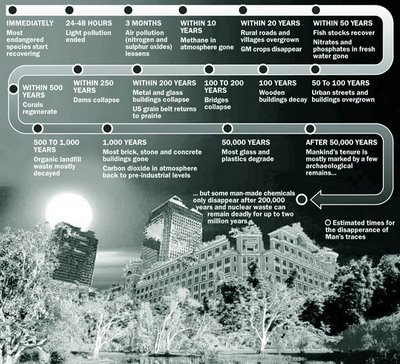
Given the age of the earth this also makes me wonder if there have been past civilisations that have completely disappeared.
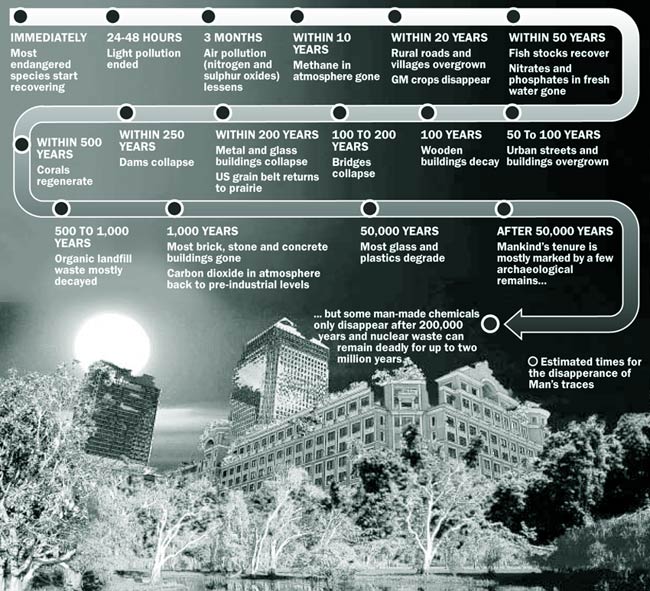
Given the age of the earth this also makes me wonder if there have been past civilisations that have completely disappeared.
Snippet
"At present Scotland's 1.33 million hectares of woodland - one-third state-owned Forestry Commission, two-thirds private - cover 17 per cent of the country. That compares with only 5 per cent a century ago, but lags well behind the European Union average of 36.3 per cent tree coverage and the world average of 29.6 per cent.
Recent attempts to encourage planting in Scotland have been hampered by the halving of timber prices since the mid-1990s and a complicated system of planting and maintenance grants for landowners, farmers and communities."
Recent attempts to encourage planting in Scotland have been hampered by the halving of timber prices since the mid-1990s and a complicated system of planting and maintenance grants for landowners, farmers and communities."
Air pollution takes six months off your life
"it concludes, about 310,000 Europeans die from air pollution each year. More than 90 per cent of the toll comes from tiny particulates that cause heart failure. They are emitted by traffic (particularly diesel engines), industry and domestic heating. The other deaths are due to respiratory diseases caused by ozone, produced when sunlight reacts with pollutants emitted by vehicle exhausts.
Across Europe, the report adds, life expectancy is reduced by 8.7 months as a result of breathing in pollution. Britain does better than most countries, with an average of 6.7 months of life lost.
Germany has the most deaths, more than 65,000 a year, followed by Italy at 39,000, with France third and Britain fourth. Luxembourg, with its small population, has the least, at 282 a year, followed by Estonia, with 456.
Lost life expectancy is worst in Belgium, where on average people lose 13.6 months of life, and the Netherlands, at 12.7 months. The Finns are the least affected, losing just 3.1 months on average, followed by the Irish at 3.9 months."
Across Europe, the report adds, life expectancy is reduced by 8.7 months as a result of breathing in pollution. Britain does better than most countries, with an average of 6.7 months of life lost.
Germany has the most deaths, more than 65,000 a year, followed by Italy at 39,000, with France third and Britain fourth. Luxembourg, with its small population, has the least, at 282 a year, followed by Estonia, with 456.
Lost life expectancy is worst in Belgium, where on average people lose 13.6 months of life, and the Netherlands, at 12.7 months. The Finns are the least affected, losing just 3.1 months on average, followed by the Irish at 3.9 months."
Subscribe to:
Posts (Atom)