Showing posts with label scuba. Show all posts

Salvaging the German High Seas Fleet wrecks of Scapa Flow

High Seas Fleet
Scapa Flow is a sheltered anchorage in the Orkneys, to the north of the Scottish mainland. During the First World War it was the main anchorage for Britain's Grand Fleet.

After the end of the First World War 78 ships of the German High Seas fleet were interned in Scapa, with some of the original crews aboard each ship. On the 21st June 1919 the German sailors began scuttling the ships and 51 battleships and other vessels went to the bottom of the Flow. The British succeeded in beaching a few ships before they sank.

Between the First and Second World Wars many of the ships were raised in an extraordinary salvage effort.


The potential rewards to the salvors were great. When the battleship Freiedrich der Gross was raised and broken up she yielded 18,943 tons of ferrous metal and 774 tons of lead, brass. gunmetal, copper and other non-ferrous metals. These metals were worth a total of £134,886.

The problem was, how to raise almost 25,000 tons of ship from the seabed.

The solution was ingenious and dangerous.

Long steel tubes containing airlocks were lowered down and welded to the ships hulls by divers. Some of these tubes were over 30m long. Air was then pumped into the hulls to begin forcing out the water. Workers would row up to a tube, climb down the inside, through the airlocks and work inside the ships whilst they lay on the seabed.


Being inside one of these huge ships whilst it was still on the seabed must have been an incredible experience.


When the ships had been made completely airtight more air was pumped in and the ships raised and towed away to be salvaged. The photograph below shows the battleship Von der Tann passing under the Forth Bridge to be broken up at Rosyth. The Von der Tann fought in the Battle of Jutland. She put two salvos of 280mm shells in the British battlecruiser Indefatigable, causing a magazine explosion and the loss of the ship and all but two of her 1,017 crew.


The salvage operation was an arduous and risky business, and there were several fatalities. The full story is told in S C George’s excellent 1973 book 'Jutland to Junkyard'. A total of 26 destroyers, five battle cruisers, seven battleships and a cruiser were raised in the heroic salvage effort.


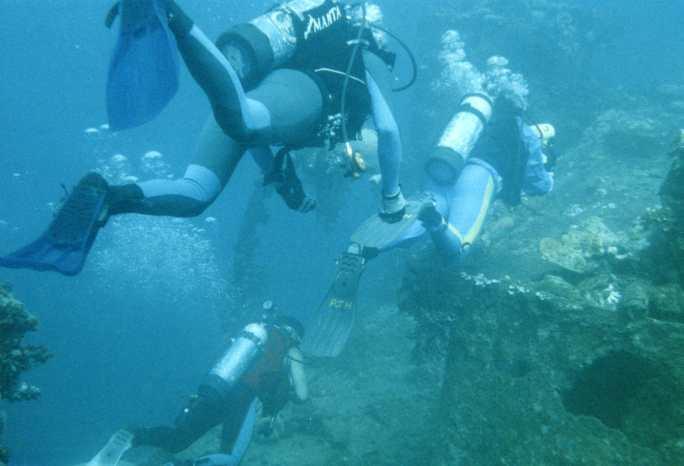
Not all the German ships could be raised and there are still ten wrecks remaining, including three battleships and four cruisers. I once spend a week diving some of these.

These wrecks, in addition to six other German wrecks, 28 British wrecks, 33 blockships and the massive wrecks of the British battleships HMS Vanguard and HMS Royal Oak, make Scapa Flow a wreck divers heaven. The only remotely comparable site is Truk Lagoon, but it does not have the big ships. Many of the turrets of the German battleships fell out when the ships rolled over as they sank. Some of these turrets weighed over 1,500 tons; heavier than most of the ships sunk at Truk.

The German battleships are so large that it takes several dives to adequately cover each wreck. Often it is hard to tell where you are on a wreck. All three of the battleships are below 130 feet and at the limit for compressed air diving. The development of mixed gas diving has made the wrecks more accessible.


Since the first atomic tests in the 1940s all new steel is contaminated by the radioactivity that is present in the air and is drawn into the furnaces during production. When uncontaminated steel is needed for medical and scientific instruments it can only be obtained from metal produced before the first atomic test. So it is that small amounts of steel are occasionally salvaged from the Koenig to make instruments. Some of these instruments are used in the space program and part of a WWI German battleship has been to the moon.

More images after the break

Dangerous sealife

There are lots of dangerous underwater creatures. The most dangerous is not the shark, as most people imagine. I have dived with sharks many times, and never had the slightest problem. I've even touched several sharks. Probably the riskiest encounter I ever had with a shark was during a night dive in the Red Sea. When we got out of the water my buddy told me that during the dive he had shone his torch behind us, and seen that we were being followed by a large shark. The consoling thought about that was that it would probably have taken him first.
Sea snakes are supposed to be six times as poisonous as the most venomous land snake. Yet we very rarely hear of anybody being bitten by a sea snake. I've dive with them several times and really enjoyed the experience. I once went on an expedition to the Swain Reefs, off Australia, specifically to dive with sea snakes. They're very curious creatures and will come up to you to see what you are and will twist themselves around your body. As long as you don't panic and try and strike out at them there's no cause for anxiety.

The really dangerous underwater creatures are the small and poisonous. Once when I was diving in the Red Sea I was just about to touch a piece of the reef when a passing Israeli diver stopped me. I had just been about to put my ungloved hand on an extremely well camouflaged and extremely poisonous stonefish. If I had touched the stonefish I would've been lucky to have survived.

The crowd of thorns star fish destroys coral reefs. They're been spreading through the barrier reef for many years and they leave devastated areas of white coral in their wake. I used to have the habit of stabbing them with my dive knife whenever I saw them. That stopped when I got a bit of thorn in my finger and was quite ill for several days. I was lucky, I heard of somebody who had to be airlifted off a dive boat to an Australian hospital after they had the same kind of accident.

Even seashells can be dangerous. The 5 inch long geography cone has killed well over a dozen people. I've collected seashells from various places around the world and one of the specimens I have is a textile cone. Once, when I was visiting the Red Sea, someone picked up one of these cones on a beach and put it in in the pocket of his shorts. The creature inside was still alive and bit him through his clothing. He died within 24 hours.

I once had a chance to dive in a lake that had a crocodile in it. I have always been a bit wary about crocodile and wasn't entirely sorry when the expedition was canceled at the last minute when somebody had an accident.

Neville Coleman, the Australian diver, has published an interesting book called Hazardous Sea Creatures. This lists all the worlds dangerous marine life. My favourite is the mantis shrimp, also known as the thumbsplitter. To quote Neville's book "the shrimp's claws are normally carried at the ready folder to beneath the shrimp's head. When hunting, or when defending, these claws can be shot at with extraordinary power and speed, and the been known to crack aquarium glass. They should only be handled if you're wearing heavy duty gloves."

The George Bush Wreck

Former US President George HW Bush has just died at the age of 94. He was the 41st US president and served between 1989 and 1993.

During WW2 he was a US Navy carrier pilot on the USS San Jacinto. This was at a time when being a naval aviator was incredibly dangerous. Many did not survive training. Flying off a carrier was dangerous and navigating back to a carrier after a mission offered many opportunities for fatal errors.

In 1943 Bush piloted one of four Grumman TBM Avengers that attacked the Japanese installations on Chichijima. He was shot down and spent four hours on a raft before being rescued by a US submarine. Several of those shot down during the attack were executed, and their livers eaten by their Japanese captors. He took part in another 58 combat missions when he returned to the San Jacinto in 1944. At least one of those must have been to Palau.

Some years ago I visited Palau on a diving expedition.  There are a lot of WW2 wrecks  of ships and planes off Palau. One of them is a 150 foot armed Japanese trawler that Bush sank on the 25th July 1944. It lies at a depth of 40ft in the  northern atoll of Ngeruangel. I did not dive it because it was too far away from the main diving areas. Palau has many more accesible non wreck dive sites, including the famous Blue Corners and Chandelier cave.

In 2002 an expedition visited the Bush wreck.  During the 1988 presidential election campaign in the USA some political figures claimed that the ship  was an unarmed fishing trawler and not a military vessel. The divers found boxes of ammunition including hundreds of standard rifle bullets and 40mm anti-aircraft  cannon shells. The remains of gun/canon mounts were also identified among the twisted metal. 

In 1944 the US was  conducting Operation Starvation to force Japan to capitulate. That meant all Japanese ships became targets. The trawler would have been a legitimate target for Bush, armed or not.

The wreck was first found by Dan Bailey. He has written books about and produced maps of  the wrecks of Palau and Truck. I have framed copies of both maps. The Truk map is still available online.

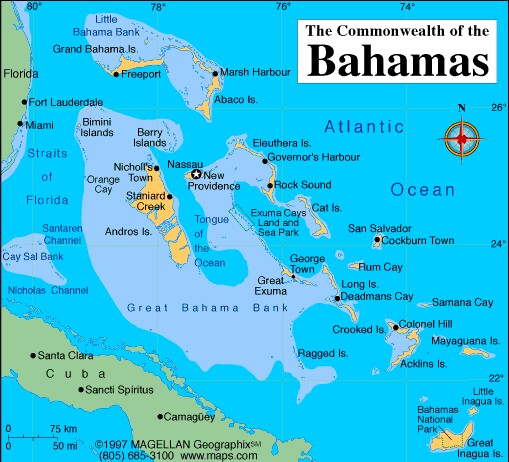
Diving Andros- Over the Wall to 185'


Because the Caribbean is cut off by the cold Atlantic there is not the same rich variety of underwater life, and the coral and fish life in the Caribbean do not in any way compare to that in the Pacific or in the Coral Sea.

The islands of the Bahamas tend to specialize in other forms of diving. Some islands offer shark diving and the chance to take part in shark feeding sessions. Andros Island’s unique feature is that it has some of the best wall and cave diving in the world. The only area I know that has better cave diving is the Yucatan Peninsula in Mexico.

The underwater caves of Andros are called blue holes. Some of them are accessed from the sea, others have a land entrance. I have written a separate posting  about one of the best inland sites, the Guardian Blue Hole.

On the east side of the island there is an almost vertical wall which falls down 6,000 ft into the Tongue of the Ocean. One of the best dives on this wall is a night dive to 185 ft. The usual procedure with this dive is to first do it as a day dive to check out ones susceptibility to nitrogen narcosis. The effects of nitrogen narcosis start to occur at about 100 ft, though individual resistance varies considerably. The symptoms are similar to those of drunkenness. These include a loss of coordination, a sense of elation and poor judgment. As the condition gets worse a diver may believe he can safely go deeper, or dispense with his breathing apparatus. The onset of nitrogen narcosis is rapid and recovery is equally rapid.

There are other risks associated with diving at this depth. One hundred feet usually is considered the maximum depth for safe diving. At 185 ft there is a very small margin for error.


The night dive starts with a boat ride out to the edge of the underwater wall. After anchoring and equipment checks it’s just a matter of going straight down until you get to a ledge at 185 feet. During the day dive you can hover at this point and look straight down into the abyss. The view is stunning.

At night there is another trick. If you cut open a Cylume [a chemical light stick] the contents of the stick disperse into the water and provide a psychedelic light show. This is a spectacular effect but you have to constantly monitor your air consumption [at this depth you use a lot] and the progression of nitrogen narcosis. You will certainly be suffering from the ‘narks’ but the trick is to start your ascent before the condition gets beyond recovery.

You also have to keep a very good eye on your buddy in case they start showing symptoms, and hope they are doing the same for you. Any mistakes at this point and it is a long fall down to the bottom of the wall at 6,000 ft.

Slate Wreck


I was reading this article in Wikipedia about the Welsh slate industry and came upon the following line.

Slate has been mined in north Wales for several centuries — this was recently confirmed by the discovery of the wreck of a wooden ship carrying finished slates in the Menai Strait which dates from the 16th century.

It reminded me of the time I dived a slate wreck in the Sound of Mull, off the west coast of Scotland. The wooden hull of the boat had rotted away, leaving behind its cargo of roof slates. These were neatly stacked up on the seabed. They looked rather strange amongst the rocks and seaweed. I was told by the dive boat skipper that the boat had been transporting a family from one part of Scotland to another, and they had been carrying their roof slates with them as being too valuable to leave behind.

When I read the Wikipedia article I did a search for slate wreck and Mull, and found this article. Apparently the boat was called the John Preston, and had been carrying a cargo of slates from Wales to Scotland. The boat had gone down in a storm, but the crew of six had managed to scramble ashore.

There are a lot of wrecks around Great Britain. Two world wars, submarine warfare and a lot of bad weather have seen to that. I remember diving a site off the Scilly Isles.A gully  contained three wrecks stacked one on top of the other. They gone down at different times, but the locals had only known about the first and the third. The middle one had gone down in a storm and all the crew had been lost. Nobody had known about the lost ship until divers chanced upon the wreck gully.

One reason there are a lot of wrecks off the Scilly Isles is because the locals used to support themselves by luring ships onto the rocks and then ransacking them.

Stop Engines


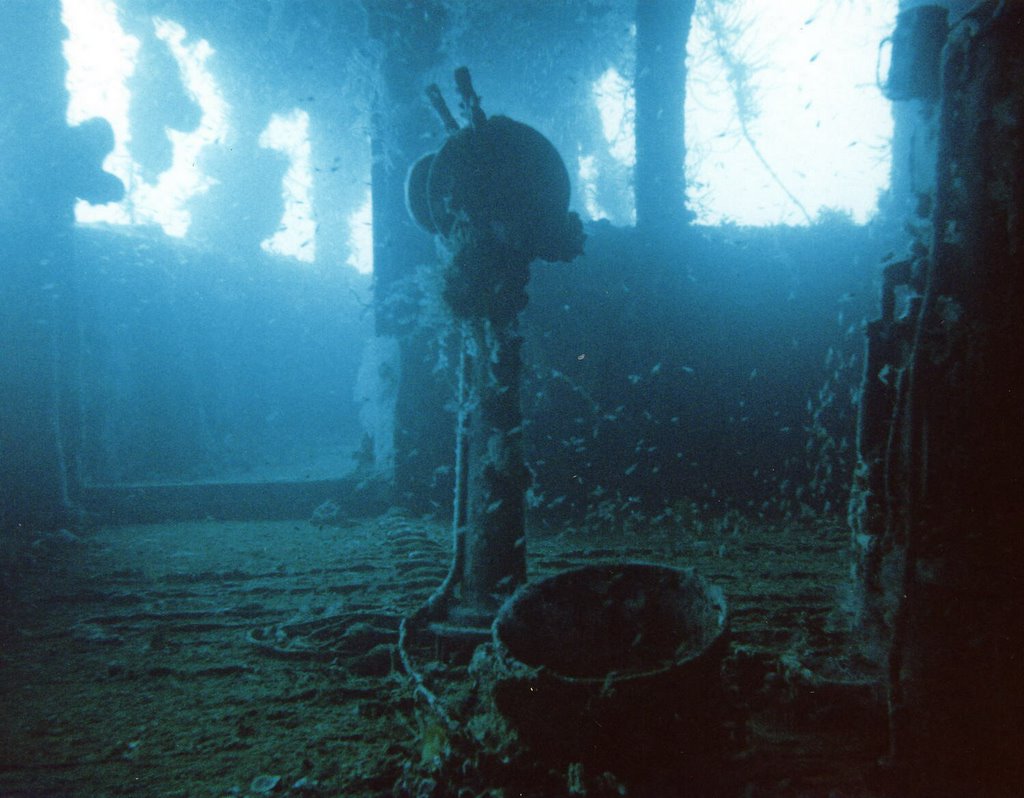
The bridge of a Japanese freighter sunk in Truk [Chuuk] Lagoon in 1944 during Operation Hailstorm. The flecks in the water are small fish. There were a lot of unexploded WW2 munitions on this ship.

The Worlds Best Dive Locations


Wikipedia has a page on the Seven Wonders of the World; with various lists, including a list of underwater wonders -

Northern Red Sea
Palau
Belize Barrier Reef
Great Barrier Reef
Deep-Sea Vents
Galapagos Islands
Lake Baikal

Some of these can be dived, but not all. The deep-sea vents could only be visited if you had your own submersible.

I thought I would draw up my own list of the worlds best dive locations, and came up with the following

Northern Red Sea
Palau
Coral Sea and the Yongala wreck
Underwater cave systems of the Yucatan
Scapa Flow and the German High Seas Fleet wrecks.
Truk and the Operation Hailstorm wrecks
Channel Island kelp forests off California
Blue holes of Andros


Palau and the Red Sea appear on both lists. There are wrecks at both locations but they are particularly famous for their reef life. The Red Sea around Ras Mohammed and the Straits of Tiran has incredible hard and soft corals; though those at Palau are even better.

I have already posted about Scapa Flow, Truk, Andros and kelp forests. The Coral Sea has superb marine life and incredible underwater visibility, especially when you get to the outer reefs. The Yongala is a steamship which was lost off Australia in 1911, and not found until 1958. Because it stands alone on a flat sandy seabed it has attracted an incredible range of marine life. There are lots of sea snakes, turtles and big fish.


The Yucatan and Andros are on the list because of their underwater cave systems. I think they offer the best cave diving in the world. I have posted  about cave diving at both locations.

There are two other locations which should be on the list but I only know them by reputation. They were on my to do list but I ran out of time.

Bikini Atoll and the atomic test wrecks.
Galapagos

The Guardian Blue Hole

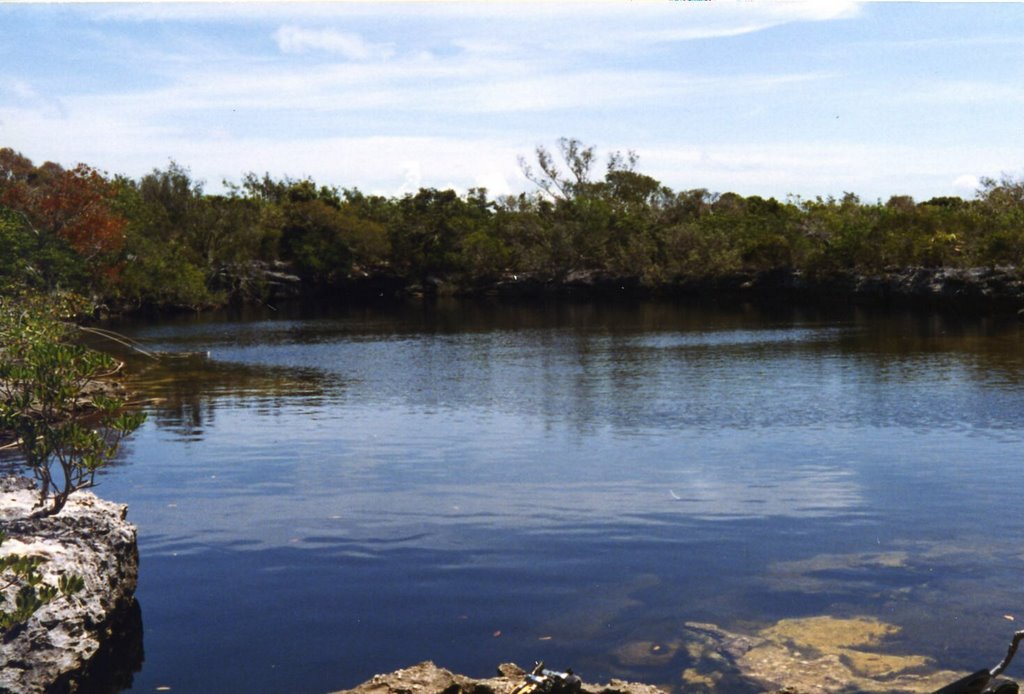
Andros is the largest island in the Bahamas. It is flat and largely empty, with a population of only 6000. Some people go there to fish. Others visit to dive the barrier reef, though I would not recommend doing that. The Caribbean is cut off from other tropical waters by the cold Atlantic and has a very poor range of corals and fish.

However, it does offer some exciting diving of a different kind, and that was why I went there. The island sits on the edge of the steep oceanic trench called the Tongue of the Ocean. This means that when you dive off one side of the island you don't see a long low reef, but an underwater wall which goes down and down to 6000 feet. If you've seen the film The Abyss you have an idea of what the conditions are like. Some parts of that were filmed off Andros.


I did some wall diving whilst I was there, and have written about that in a previous posting. See the Over the Wall to 185' post.

The main attraction of Andros is its blue holes. These are underwater cave systems. Some are inland; others are entered from the ocean. Rob Palmer wrote about the blue holes of Andros in his book Deep into Blue Holes which was published by Unwin Hyman Limited in 1989. ISBN 0-04-440380-1. It's a very good read if you can manage to get a copy.

I dived several of the blue holes. The best of these was the Guardian Blue Hole. The guardian of the blue hole was a barracuda, a half blind brown barracuda. The Guardian is an inland blue hole so it was strange that it should have a barracuda in it. Some people think the presence of the barracuda indicated that the Guardian Blue Hole had a link to the sea. Others thought that somebody had introduced the barracuda, or that it had been swept in by a tropical storm while still very small.

Life in the blue hole had not suited the barracuda. Rotting vegetation had put a lot of tannin in the water and this had colored the barracuda brown and damaged its eyesight. Perhaps it had also made it a bit testy.

My partner for the dive had been to the blue hole a lot of times before. He told me that he had been feeding the barracuda, and that he had trained it to eat sausages from his hand. He said it had bitten hime three times and would have to wear thick gloves in case it snapped at our hands. This was not good news for another reason. My partner was in a thick protective wetsuit, but I was wearing a thin and very tight Lycra suit. So thin and tight that some anatomical features were prominent. The idea of a half blind sausage eating barracuda rather alarmed me. I wondered how easy it would be to fin in a crouching position.


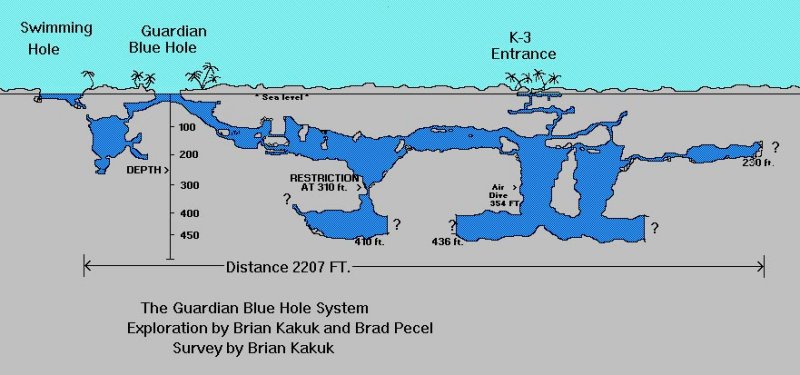
We were diving with double tanks, in fact double everything, to provide redundancy in case of an equipment failure. Once we had donned all the kit and jumped into the water it was only a few tense minutes before we were at ten meters, through the tannin layer and below the realm of the barracuda. That was a relief. The next part of the dive involved following a fixed line to a large cavern at about 40 m and then ascending to a point where there's a constriction in the tunnel. To progress beyond this point you need to remove your tank and push it ahead of you through a very tight hole. The rest of the cave layout is shown in the map below. These caves were once above water, and you can see the stalactites that formed then.

When we got back to the tannin layer the barracuda reappeared. I had wondered if the bit about the sausage eating was just a story to make my meat creep but these doubts disappeared when the barracuda appeared to snap at my partner several times. I didn't tarry in the water when we got back to the surface.


The Guardian Blue Hole was a very good dive. In fact, all the wall and blue hole dives that I did on Andros were outstanding. The best place to stay on the island is at Small Hope Bay lodge. They have a menu of specialist dives, and can provide equipment and transport. This is the only place in the world that I know of where you can do really deep wall dives [180-190 feet], plus a range of cave and cavern dives.

California Kelp Forests


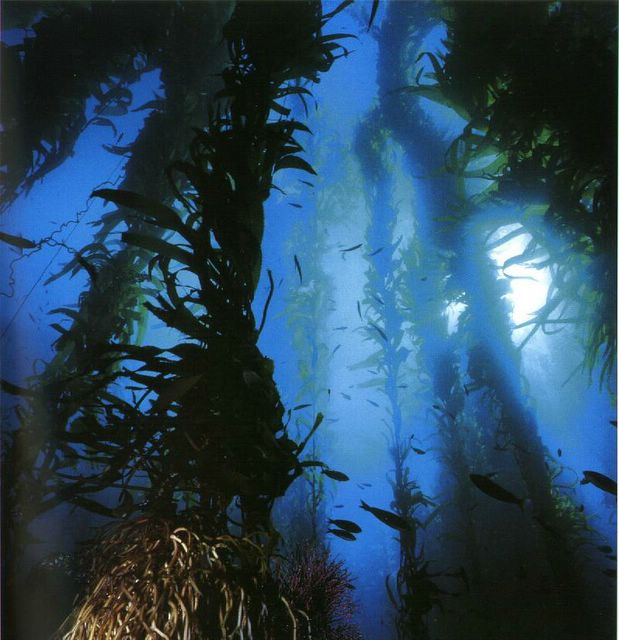
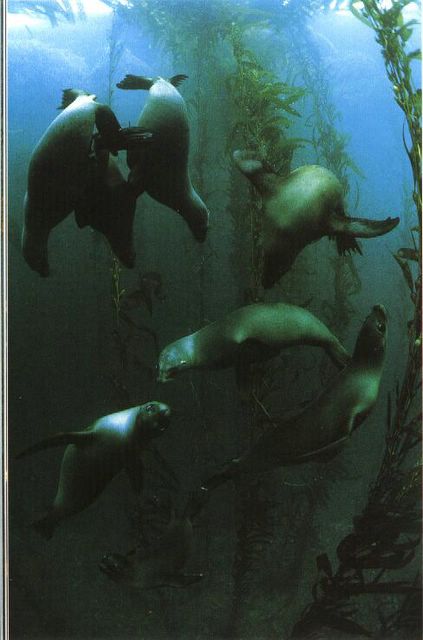
There is an underwater forest off the coast of California. The trees of this forest are Giant Kelp plants. These plants are secured to the sea bed by holdfasts and can grow up to 80 feet tall. The stipe, which extends from the holdfast to the surface, has gas bladders which keep it upright in the water. The plants create a excellent environment for many forms of life and seals and otters are common in the kelp forests. They also provide a marvellous diving experience. Swimming high through the sunlit fronds of a kelp forest is like flying like a bird through the trees of a forest on land.


The kelp forests are found along the coast of Southern California and can be dived from the shore. I have dived with otters in one off Cannery Row in Monterey. However, the best forests are found around the Channel Islands. The water there is clear and deep and this allows the plants to grow much longer. This creates a more spectacular diving environment and the underwater visibility can be excellent. At the right time of the year [August through to October] it can be 60-70 feet.

I would rate the Channel Islands as one of my top three dive locations [the other two being the underwater caves of the Yucatan and the Great Barrier Reef]. It provides a completely different experience to reef diving and is an excellent thing to do if you have a few days stopover at LAX on your way from the UK to Australia or New Zealand.

It is easy to dive the Channel Islands. Several large, live aboard, dive boats operate out of Santa Barbara, and out of San Pedro, the nearest port to Los Angeles. There are also plenty of dive shops where equipment can be hired, including the necessary full wet suit. Kelp plants do not like temperatures above 68 degrees Fahrenheit and water temperatures range from cool to cold. The dive shops will also provide a complete package of equipment and dive boat bookings.

Truk Lagoon

The world's two best wreck diving sites are Scapa Flow in   Orkney and Truk [Chuuk] Lagoon in the Pacific.


Scapa Flow

At the end of the First World War ships of the German High Seas fleet was scuttled at Scapa. Most of the ships were salvaged between the wars but three battleships [Kron Prinz Willhelm, Konig and Markgraf] remain, as well as a number of cruisers. There are also a lot of other wrecks at Scapa, it was the main anchorage for the British Navy during both World  Wars.

Truk Lagoon


The other is Truk [now known as Chuuk] Lagoon in the Pacific.  . On the 17th and 18
th February the Americans launched an air attack from a carrier fleet to destroy the Japanese ships at Truk. The attack was known as Operation Hailstorm.  

The Japanese had feared that an attack might be imminent and moved most of their heavy warships, but the Americans still managed to sink twelve smaller warships and 32 merchant ships, and destroy over 250 aircraft. All these wrecks are still at Truk, along with the wreck of the Japanese submarine I-169 [Shinohara]. The submarine submerged to hide from the attacking dive bombers, but was then unable to surface and all the crew were lost.

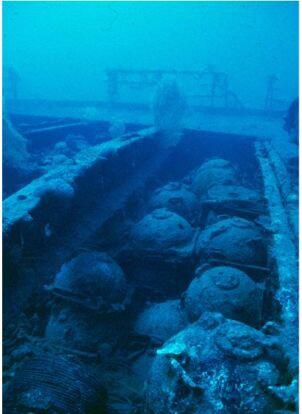
The wrecks are at varying depths. The mast of one protrudes above the water, another is at 250 feet. Coral has started to cover the wrecks; especially the shallower ones. All the mines, bombs, guns, tanks and other military supplies that were in the freighters are still there, and some of the wrecks are very dangerous. 


On one wreck that I dived oil was still bubbling out of the ship over fifty years after its sinking. Several thousand Japanese perished in the attack, and there are still human remains on many of the ships. The local dive guides keep stashes of skulls etc and will bring them out for visiting divers to photograph.

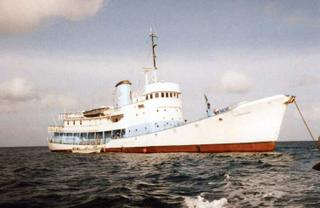
There are several dive operations serving the lagoon. I stayed on the SS Thorfinn, a former whale catcher, which as been converted to a live aboard dive boat. There is nothing to do on land and a boat gets one away from the insect life.
Apart from the wrecks, Truk is an unattractive place. There is not much money about and the main occupations seem to be religion for the women and beer for the men. I noticed several American missionaries being greeted at the airport when I arrived, and on the drive to the dock we passed several huge stacks of empty beer cans by the side of the road.

Piccaninnie Ponds

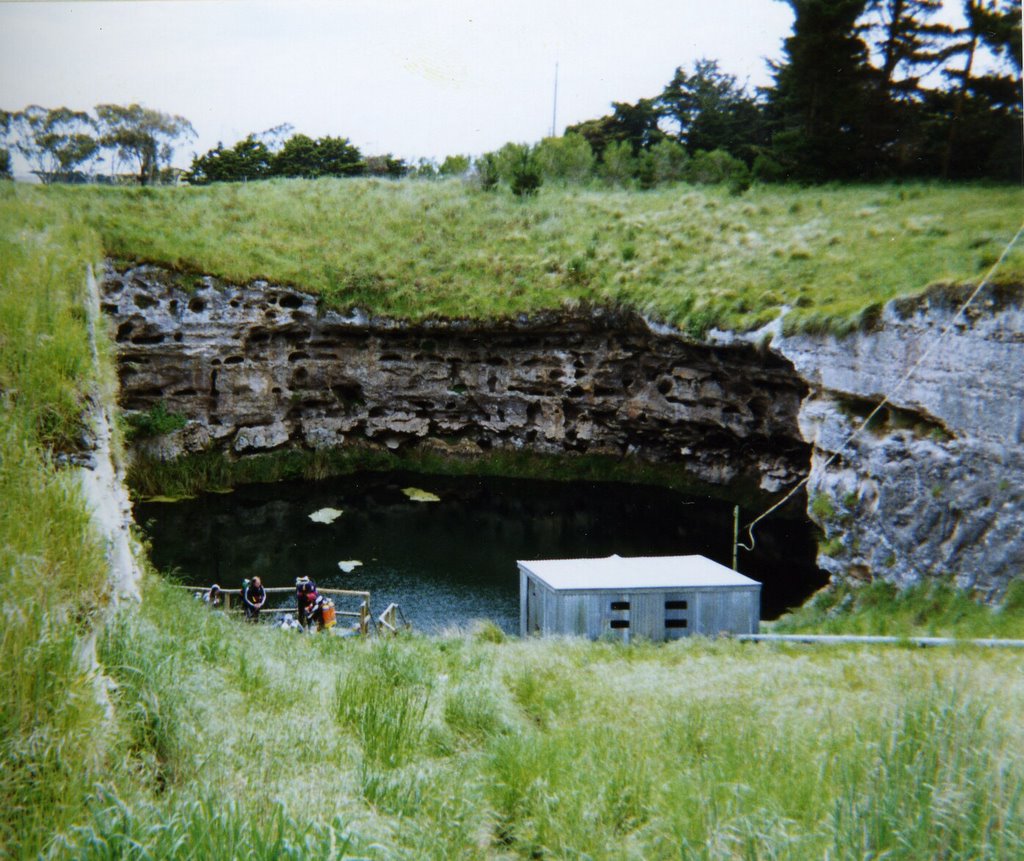
The seas around Australia, particularly the Coral Sea, offer some of the best open water diving in the world. Less well known are the freshwater cave and sinkhole dives around Mount Gambier in South Australia.

This area has the finest cave diving in Australia, with over 40 sites available. One of the finest  is Piccaninnie Ponds.


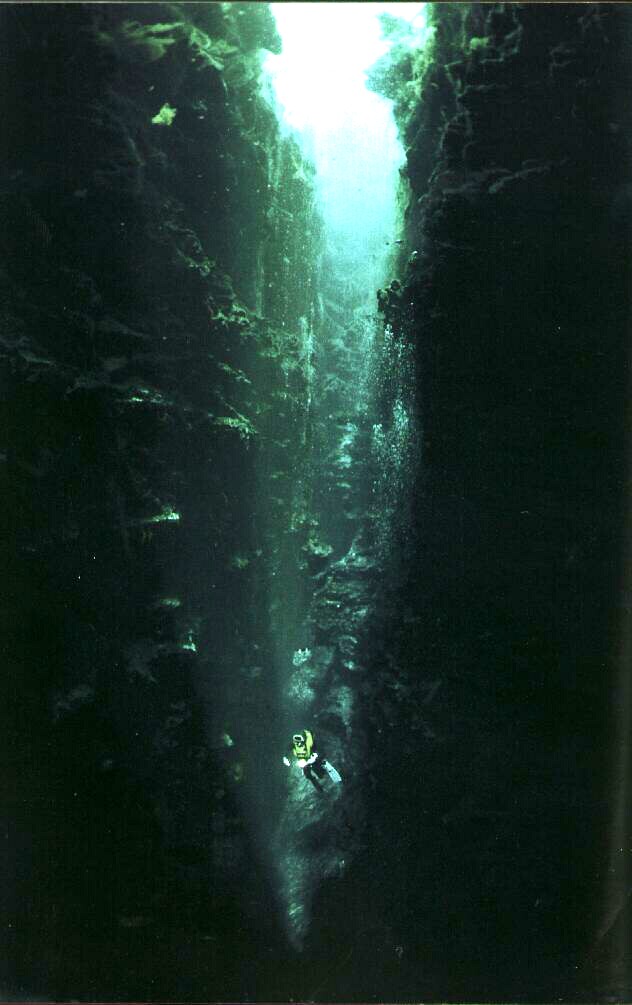
The marvellous photograph below, from the January 1984 issue of National Geographic, catches it perfectly.
On the surface it is a small lake surrounded by reeds. Below the surface there is a chasm which is 5m wide by 50m long and 60m deep. At 10m divers can swim through an opening into the Cathedral. This is a beautiful cave that is 30m high and 20m wide. The walls are clean white limestone. There is very little silt and the exits are clear so there is no need to run a line.

Divers can exit the Cathedral through another opening at 25m to swim down to the bottom of the chasm at 57m. At the very bottom of the chasm is the entrance to a tunnel that goes no one knows quite where; though some have died trying to find out. The tunnel is narrow and once in offers few opportunities to turn around. One can only stay at the this level for a few minutes since 57m is almost twice the maximum safe depth for air diving. This video shows a dive down the tunnel.

The real attraction of Piccaninnie Ponds is the remarkable clarity of the water. It is as clear as tap water. Visibility must have been 40m when I was there and gave me the sensation that that I was  flying in air. If the dive is done at the right time on a bright sunny day the sunlight illuminates deep into the chasm and creates a magical effect.


Several divers have drowned in Piccaninnie Ponds. Divers now require a permit from the Department of Land Conservation and this is only granted to people holding the Deep Cavern  certification of the Cave Divers Association of Australia. If you are in that part of the world and already cave certified it is well worth contacting the CDAA and getting approval to dive the Ponds.

There are no technical difficulties and it can be dived with just a single tank rig. I found it an excellent dive and a worthwhile entry in any logbook.

Dos Ojos 150m free cave dive

Carlos Coste has just set a new breath holding world record yesterday by swimming for 492ft through a cave system in Mexico's Yucatan Peninsula using just a single fin and a torch. He did not have any breathing apparatus.


There is a video of the exploit here.  If you look closely you can see the line he is following.


The swim took place in part of the Dos Ojos underwater cave system. Dos Ojos means Two Eyes and Coste swam through a tunnel linking  two cenotes. The Yucatan Peninsula has hardly any surface water.  All the water runs through subterranean tunnels. In places tunnel roofs have collapsed and created cenotes. A cenote is just an opening to the surface.


I have actually dived the route [post] that Coste took [but I was wearing full cave diving kit, not holding my breath].  Its a superb dive.

Diving Dos Ojos


Many years ago I read Desmond Bagley’s 1984 book ‘The Vivero Letter’ [ISBN 0 00 612669 3] about a group of people who go off to dive for treasure in the cenotes of the Yucatan Peninsula of Mexico. There is very little surface water in the Yucatán Peninsula and the Mayans had to live close to cenotes to get fresh water. They used to throw human sacrifices and valuable objects into the cenotes because they believed that they were gateways into another world [in fact they were right about that, though not in the way that they believed]. Bagley’s book was probably inspired by the work of Edward Thompson, who found large amounts of treasure in the cenote at Chichén Itzá between 1904 and 1907. The October 1961 edition of the National Geographic magazine has two articles on some later work at Chichén Itzá.

The Vivero Letter is well written and an entertaining read. It's been reprinted recently and Amazon have copies. The book gave me the idea that that one day I would like to do some cenote diving.

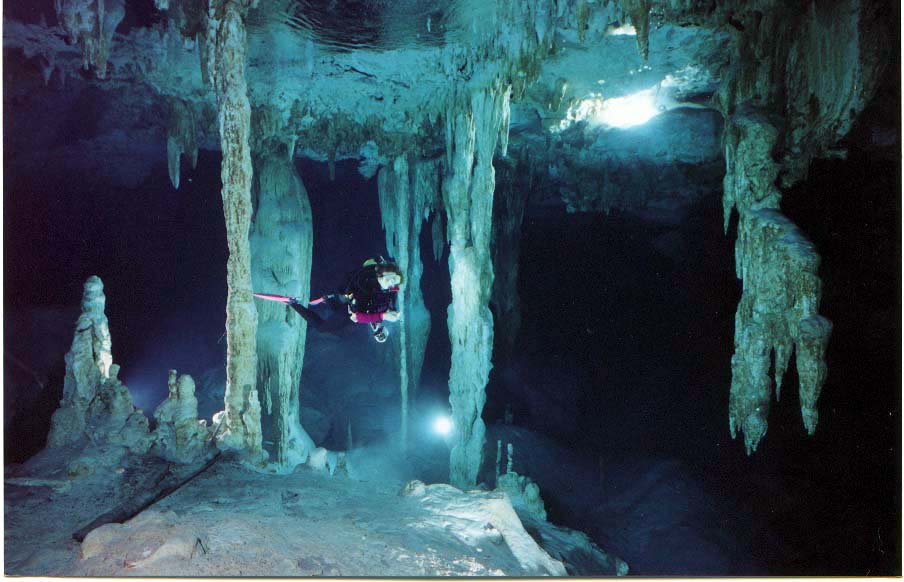
The cenotes are not gateways to the underworld, but they are gateways to the best cave diving in the world. Most of the water in the Yucatán Peninsula runs underground through a series of tunnels. Cenotes are created when the roof of a tunnel collapses at some point. Divers can enter the tunnel system through the cenotes and travel for miles through the flooded caves. About 6000 cenotes have been located and some of these have become popular with cave divers. Particularly those around Akumal; which is on the mainland across from Cozumel.

My favorite is Dos Ojos [Two Eyes]. My favourite Dos Ojos dive involves a 45 minute traverse between two of the main Dos Ojos cenotes. This is only part of the total system. The complete Dos Ojos system is one of the largest underwater cave networks in the world and connects a number of cenotes. The traverse between the two cenotes is a fantastic dive, and can be combined with a visit to the nearby Bat Cave, with its incredible stalactites.


The Temple of Doom is another excellent dive. There is quite a narrow opening to this system and you have to start the dive by jumping about 10 feet down into the water [there's a ladder to help you get out].


A video of a dive in the Temple of Doom.

Divers need special training and equipment before tackling any of these dives. Redundancy is the key feature of cave diving equipment. Divers need to have duel air tanks, dual regulators and multiple torches. It is essential to have a backup if any of your equipment fails. It is also essential to either follow the lines that have been laid in the caves, or lay your own lines. It's very easy to get lost in these caves as you can see from the photographs. Without lines to follow one soon becomes disoriented and unable to find a way out. There been some disastrous incidents when inadequately equipped and untrained open water divers have tried to dive the cenotes.

Update November 2010

Here is a video of a free diver who swam thru Dos Ojos whilst holding his breath.

Diving the world


I used Wayfaring to create the map and generate the html to paste into this blog post.

Air Rings


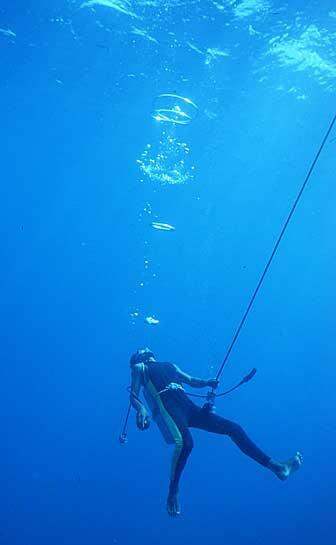
A diver blowing air rings during a decompression stop. They expand as they rise and appear to be spinning rapidly.