Showing posts with label bloggers selection. Show all posts

The Certosa di Pavia


The foundations for the Certosa di Pavia [aka the Carthusian Monastery of Pavia] were laid in 1396. Over the centuries patrons came and went, but enough money flowed to the monastery to create what I think is the finest building in the world. What makes it my favourite is not only the architecture [the marble facade is considered by many to be the most beautiful monument in Italy], the frescoes in the church and the monks cells around the Great Cloister. It is also the sense of tranquillity that pervades the entire monastery.

The  Grand Cloister with the church in the background

The Small Cloister

The lavabo where the monks could wash their hands


The Certosa consist of both the superbly decorated church and the cells of the monks which are situated around the Grand Cloister.  The Carthusians were hermits. They worked in the fields and prayed together, but otherwise kept to their individual cells. These cells are really individual houses. Each has a cellar, two rooms downstairs and two rooms upstairs. Each house has its own walled garden where the monks could pray [and contemplate their good fortune].

Grand Cloister

Inside a cell


Back of a cell

In the garden of a cell

The Certosa di Pavia is a few miles outside the town of Pavia in Italy. Pavia is a 25 minute train ride south of Milan.  I have visited twice. On each occasion there were a few visitors but not the crowds that spoil so many places. The monastery is now in the care of the Cistercians. On my second visit we were shown around by an English speaking monk.  Apparently the monks do allow visitors to stay in some of the cells, though not at the moment because of restoration work.


Some other Carthusian Monasteries. The layout is very distinctive.


Grand Balcon Sud


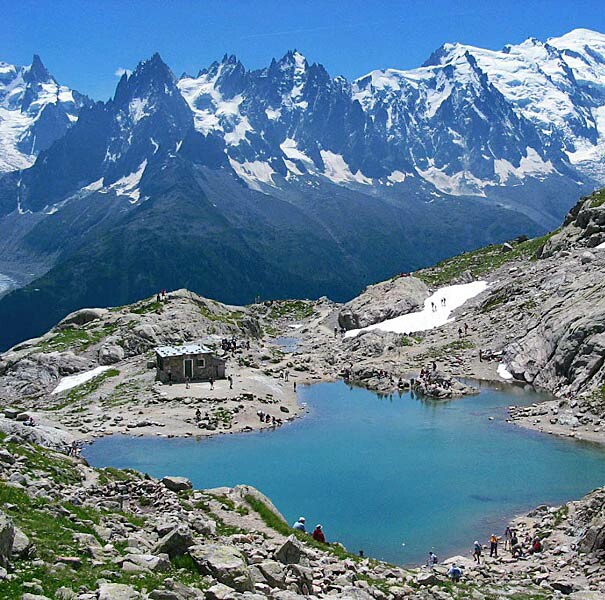
The Grand Balcon Sud is a path which runs high along the side of the Chamonix valley from Brevent to Lac Blanc. There is another very good path on the north side of the valley, but the southern path has marvellous views of Mont Blanc and the Augille du Midi.


The best way to walk the path is to take the cable car from Chamonix to the station at Brevent and then walk north along to La Flegere. This will take a few hours. From there you can take the cable car down to the valley floor and catch a bus back to Chamonix. A better idea is to walk further along the side of the valley and another 500 feet higher to Lac Blanc. There will usually be plenty of snow around even in July. When I was last there the lake was frozen solid. From the lake you can turn south and walk to the station at L’Index, then catch the cable car down via La Flegere. The path is easy enough. There is one short iron ladder to climb and poles are advisable for the sections that are still under snow. The reward is superb views across the valley. If you do the walk later in the day you will probably be able to see the paragliders launching from Brevent.

There is plenty to do in Chamonix and you can easily spend several days there. There are lots of hotels and booking is not usually necessary except in August when the French take their holidays. I usually stay at the Sapiniere. The people are friendly and it’s in a good location.

For people from the UK Chamonix makes a good stop on the way to the Dolomites. It’s about two days drive to Chamonix from Calais with lots of good places to stay along the way. When you leave Chamonix the entrance to the Mont Blanc Tunnel is only a few miles from town. Once through the tunnel you can soon be on the Italian motorway network and in the Dolomites in the same day.

Salvaging the German High Seas Fleet wrecks of Scapa Flow

High Seas Fleet
Scapa Flow is a sheltered anchorage in the Orkneys, to the north of the Scottish mainland. During the First World War it was the main anchorage for Britain's Grand Fleet.

After the end of the First World War 78 ships of the German High Seas fleet were interned in Scapa, with some of the original crews aboard each ship. On the 21st June 1919 the German sailors began scuttling the ships and 51 battleships and other vessels went to the bottom of the Flow. The British succeeded in beaching a few ships before they sank.

Between the First and Second World Wars many of the ships were raised in an extraordinary salvage effort.


The potential rewards to the salvors were great. When the battleship Freiedrich der Gross was raised and broken up she yielded 18,943 tons of ferrous metal and 774 tons of lead, brass. gunmetal, copper and other non-ferrous metals. These metals were worth a total of £134,886.

The problem was, how to raise almost 25,000 tons of ship from the seabed.

The solution was ingenious and dangerous.

Long steel tubes containing airlocks were lowered down and welded to the ships hulls by divers. Some of these tubes were over 30m long. Air was then pumped into the hulls to begin forcing out the water. Workers would row up to a tube, climb down the inside, through the airlocks and work inside the ships whilst they lay on the seabed.


Being inside one of these huge ships whilst it was still on the seabed must have been an incredible experience.


When the ships had been made completely airtight more air was pumped in and the ships raised and towed away to be salvaged. The photograph below shows the battleship Von der Tann passing under the Forth Bridge to be broken up at Rosyth. The Von der Tann fought in the Battle of Jutland. She put two salvos of 280mm shells in the British battlecruiser Indefatigable, causing a magazine explosion and the loss of the ship and all but two of her 1,017 crew.


The salvage operation was an arduous and risky business, and there were several fatalities. The full story is told in S C George’s excellent 1973 book 'Jutland to Junkyard'. A total of 26 destroyers, five battle cruisers, seven battleships and a cruiser were raised in the heroic salvage effort.


Not all the German ships could be raised and there are still ten wrecks remaining, including three battleships and four cruisers. I once spend a week diving some of these.

These wrecks, in addition to six other German wrecks, 28 British wrecks, 33 blockships and the massive wrecks of the British battleships HMS Vanguard and HMS Royal Oak, make Scapa Flow a wreck divers heaven. The only remotely comparable site is Truk Lagoon, but it does not have the big ships. Many of the turrets of the German battleships fell out when the ships rolled over as they sank. Some of these turrets weighed over 1,500 tons; heavier than most of the ships sunk at Truk.

The German battleships are so large that it takes several dives to adequately cover each wreck. Often it is hard to tell where you are on a wreck. All three of the battleships are below 130 feet and at the limit for compressed air diving. The development of mixed gas diving has made the wrecks more accessible.


Since the first atomic tests in the 1940s all new steel is contaminated by the radioactivity that is present in the air and is drawn into the furnaces during production. When uncontaminated steel is needed for medical and scientific instruments it can only be obtained from metal produced before the first atomic test. So it is that small amounts of steel are occasionally salvaged from the Koenig to make instruments. Some of these instruments are used in the space program and part of a WWI German battleship has been to the moon.

More images after the break

Data Visualisations

A fascinating site showing over 300 physical visualisations of data.

For example -


Worry Beads, one for every year from 1945 (closest in the pic), are scaled at one cc per human life. The volume of each is set by the number of terrorist-caused deaths for that year globally. The whole thing is about 40′ long, the largest bead (2014) is 19″ dia.


The mother [of] Sara Weber knitted this scarf during her daily train rides to work in Munich and used different colours depending on train delays. Every day two rows: Grey, less than 5 minutes delay. Pink, 5 to 30 minutes delay. Red, both rides delayed or one more than 30 minutes. The huge red area was during construction work, where the train was substituted by a bus.


An artwork that represents the cost of health care for different age groups, based on the time it takes for a marble to fall. Each of the 7 runs represents a different decade of life, and the length of the runs presents the average cost of care to the UK's National Health Service, for a person in that year of their life. Each run is constructed from medical equipment. It was commissioned by the British Medical Association and the British Medical Journal to mark the NHS's 70th Birthday on the 5 July 2018, and installed at their headquarters for a month.  There is a video of the artwork's construction.


This ShockWatch tilt indicator can be attached to packages which must remain upright during transportation. If the packet is tilted to either side, the little balls move into the next chamber. The recipient can then later check the degree of tilting the packet experienced during transportation. The upper row indicates tilting to the left, the lower to the right. The ball in the round indicator moves in to the outer torus when the packet is turned over 180°.

A visualisation of the Colorado River from another source -


The Lavadas of Madeira

The island of Madeira is wet in the north and west and dry in the south east. In the 16th century the Portugese started building lavadas [channels] to carry water south and east from the mountains to the agricultural regions. Madeira is very mountainous and building the lavadas was often very difficult. Many are cut into the sides of mountains.


There are also 25 miles of tunnels.


There are now over 1,350 miles of lavadas and they provide a magnificent network of walking paths through some of the finest scenery in the world. Some provide easy and relaxing walks through beautiful countryside. Others are narrow, crumbling ledges cut into the side of mountains where the slightest slip could result in serious injury or death. Two of the best are the Levada do Caldeiro Verde and the Caldeirao do Inferno. The two lavada are linked and are about 23 miles long in total. Both have a lot of tunnels and long sections which should not be attempted if you suffer at all from vertigo. Torches are essential for the tunnels. Helmets are also a good idea unless you are a midget.


On the Levada do Caldeiro Verde.

The best guide to the lavada and other walks on Madeira is "Landscapes of Madeira", published by Sunflower Books. This book won the Thomas Cook Best Travel Guide Award

This has detailed instructions on 42 lavada and mountain walks plus six road tours. The maps are superb and the book is well set out and easily carried. A good guidebook is essential because some of the levadas are hard to find. A few are signposted but many are not. I spent a couple of hours trying, unsuccessfully, to find one particular lavada. The authorities on Madeira need to recognise that the levadas are a real asset to their tourist trade and install proper signposting.

Blogger's Selection - Alexander Pope


I've always enjoyed the poetry of Alexander Pope. For example, these lines from Pope's Essay on Man

Who sees with equal eye, as God of all,
A hero perish, or a sparrow fall,
Atoms or systems into ruin hurl'd,
And now a bubble burst, and now a world.


Hope humbly then; with trembling pinions soar;
Wait the great teacher death, and God adore.
What future bliss, he gives not thee to know,
But gives that hope to be thy blessing now.
Hope springs eternal in the human breast:
Man never is, but always to be blest:


Those lines were parodied by the notorious Thomas Potter as follows

O blindness to the future! kindly given,
That each may enjoy what fucks are marked in Heaven:
Who sees with equal eye, as God of all,
The man just mounting, and the virgin's fall,
Pricks, cunt, and ballocks in convulsions hurled,
And now a hymen burst, and now a world


I particularly like Potter's first two lines.

Pope had a rather cynical view of politicians, and the power of corruption.

"In vain may heroes fight, and patriots rave;
If secret gold sap on from knave to knave.

Blest paper-credit! last and best supply!
That lends corruption lighter wings to fly!
A single leaf shall waft an army o'er,
Or ship off senates to a distant shore;
Pregnant with thousands flits the scrap unseen,
And silent sells a king, or buys a queen."

I suspect there have been several instances recently where there has been some secret gold moving from knave to knave.

A podcast about Pope on the BBC's In Our Time series rekindled my interest and I found this annotated copy of An Epistle to Arbuthnot. It is about the sad lot of the writer.

These lines could well apply to bloggers.

Who pens a stanza, when he should engross
Is there, who, lock'd from Ink and Paper, scrawls
With desp'rate Charcoal round his darken'd walls?


And

Why am I ask'd what next shall see the light?
Heav'ns! was I born for nothing but to write?
Has life no joys for me? or (to be grave)
Have I no friend to serve, no soul to save?


And these later lines could well be applied to many in the media, especially those who write for the British tabloid press.

Damn with faint praise, assent with civil leer,
And without sneering, teach the rest to sneer;
Willing to wound, and yet afraid to strike,
Just hint a fault, and hesitate dislike;


Pope had a sharp pen and many of his writings, including An Epistle to Arbuthnot, contain sly digs at his many enemies, and even some of his friends.

But foes like these!" One flatt'rer's worse than all.
Of all mad creatures, if the learn'd are right,
It is the slaver kills, and not the bite.
A fool quite angry is quite innocent;
Alas! 'tis ten times worse when they repent.

Unique chess set made using fourteen different woods

This chess set has been made using fourteen different woods; including mahogany, walnut, flamey birch, spalted hornbeam, zebrawood and douglas fir.


The board is made of 1cm thick pieces of mahogany and sycamore, with a plywood substrate. Rows one and eight are raised up 2cm. Rows two and seven are raised 1cm. The case is made of flamey birch and has been treated with diluted tung oil to bring out the figuring.


The 'dark' pieces have been made using six different woods.

Rook - douglas fir treated with diluted tung oil.

Knight - zebrano [aka zebrawood].

Bishop - walnut.

King and Queen - oak treated with diluted tung oil.

Pawns - body is ebony, head is dyed beech.

The pieces have been designed according to their direction of travel. A rook can move forwards, backward or side to side.  A knight can move one square forwards, backward or side to side plus one square diagonally. A bishop can move diagonally.

The king and queen can move in any direction. Their direction of travel has been indicated by their bases, rather than by the shape of the piece.


The 'light' pieces have also been made using six different woods.
 
Rook - maple.

Knight - lime.

Bishop - cherry

King and Queen - spalted hornbeam.

Pawns - body is ash, head is beech.


Restoring the Nile Clumps

To commemorate Nelson's victory

In August 1798 a British fleet under Rear-Admiral Horatio Nelson inflicted a crushing defeat on a French fleet moored in Aboukir Bay, Egypt. The French lost fourteen ships and had 1700 seamen killed. The Battle of the Nile cut Napoleons Egyptian expedition off from France, and removed the threat to Britain’s position in India. It was one of the British Navy’s greatest triumphs.

To commemorate the victory Charles Douglas, 6th Marquess of Queensberry, planted clumps of beech trees on his estate near Amesbury in the south of England. Each clump of about 200 beech trees marked the position of a British or French ship at a particular moment in the battle. These woods are called the Nile Clumps. The trees are to the north-west of Amesbury, on either side of that stretch of the A303 that lies between the  A345 and the A344.  The site is quite close to Stonehenge.


The two fleets still sail across the Downs, but in a sadly depleted state. Beeches last about 200 years and many of the original trees have died or are dying. Some clumps were lost when the A303 was built. Others have been destroyed by farmers.

First restoration 

In 1990 The Amesbury Rotary Club replanted one clump as part of National Tree Week.  This was so successful that they got more funding and eventually replanted a total of fourteen clumps. An article in the UK's Weekend Telegraph newspaper of the 20th June 1998 described the replanting project. See the end of this post for a copy of the article.

On  Thursday 11th Apr 2002 the Amesbury Journal,  reported that

"Trees planted on the outskirts of Amesbury more than 200 years ago to commemorate Nelson's victory at the Battle of the Nile are now under the protection of a preservation order.

The order was confirmed by Salisbury district council this week, following a lengthy process to ensure the Nile Clumps, as the trees are called, are given the profile and protection that their history demands.
Each clump of trees represents the strategic position of English and French ships at the height of the epic 1798 battle."

 In July 2008 I visited the site and took some photographs. I also visited the Information Centre in Amesbury Library and they provided me with the map below. I talked to Tony Lester-Card who was the organizer of the first restoration of the clumps.

Map


The map [author and date unknown] shows the location of 26 'ships'.  Seven of these are marked as having being 'lost' over the years and nineteen as remaining. It does not show the five clumps which were lost when the A303 was built.

Marked as lost on map

Mercure 74  [F] 

Timolean 74  [F]

Guerrier 74  [F]

Conquerant  74  [F]

Audacious 74  [B]

Zealous 74  [B] 

Culloden 74  [B]


Marked as surviving on map


Majestic 74  [B]  - on aerial photo

Bellerphon 74  [B]  - on aerial photo

Alexander 74  [B]  -  on aerial photo

Orion 74  [B]

Swiftsure 74  [B]  - on aerial photo

Defence 74   [B]  - on aerial photo

Theseus 74  [B]

Goliath 74  [B] - on aerial photo

Minoteur 74  [B]  - on aerial photo

Vanguard 74  [B]  - on aerial photo

l'Aquilon 74  [F]  - on aerial photo

Spartiate 74  [F]  - on aerial photo

Heureux 74  [F]  - on aerial photo

Tonante 80  [F]  - on aerial photo

l'Orient 120  [F]   - on aerial photo

Franklin 80  [F]  - on aerial photo

l'Artemisie 36  Frigate  [F]

Serieuse  36  Frigate  [F]

Peuple Souverain 74  [F]  - on aerial photo

I examined an aerial photograph [from Google Maps] and could only find fifteen 'ships' remaining.  I think they are the ones I have indicated in the list above. It appears that in the period between the map being prepared and the photograph being taken a further four 'ships' have been lost.


The Nile Clumps in 2008

I took these photographs in July 2008.


Several of the clumps.


The Franklin clump

You can see that only a few of the Franklin's original beeches remain.  You can also see the new trees that were planted by the Rotary Club of Amesbury.


The Franklin's clump has been protected by fencing


If you look closely at this  photograph, and the one above, you can see that some of the new plantings have succeeded, but others do not appear to have made it out of their plastic tubes


Another view of the Franklin Clum


Preserving the Nile Clumps
 
What do we need to do to preserve the Nile Clumps?

1.  Plant trees
  
There were 31 ships present at the Battle of the Nile.  The British had fourteen ships of the line. The French had thirteen ships of the line and four frigates.  I would like to see clumps for all 31 ships, made up as follows.

The fifteen clumps visible in the aerial photograph.
The four clumps marked as surviving on the map but not visible in the aerial photograph.
The seven clumps marked as missing on the map.
The five clumps lost when the A303 was widened [representing the Leander 50 [B], Mutine [B], Genereux 74 [F], Guillaume Tell 80 [F] and the French frigate Justice of 40 guns. I identified these ships by comparing the list above with a list of the ships present at the battle.

Tony Lester-Card estimated that there were 70-90 beeches in each clump. If we take the higher figure and assume that all the clumps had to be replanted the exercise would involve planting no more than 2790 trees [plus a number of maples and hawthorn].  This is trivial compared to the Trafalgar Project which involves creating a series of woods across the UK, with each wood representing a ship that was present at the Battle of Trafalgar. The Victory Wood in Kent will consist of 100,000 trees.


2.   Convert the surounding land to grassland
  
Most of the restored trees are on Countess Farm owned by The National Trust  and farmed by Neil Morrison. At the moment the land around the clumps is being farmed. This obstructs access to the surviving clumps and  makes it difficult to replant the lost 'ships'. The National Trust  is planning to let some of it revert to grassland.  It needs to acquire the remaining land and convert it to grassland.

3   Manage the Nile Clumps estate
 
The Nile Clumps estate needs to be established to maintain the clumps, create access and provide information and interpretation. The National Trust seems to be the ideal people to do this. They have all the necessary skills and are well established in the area.

Update - 27th April 2009

The London Daily Mail has an article about the site and it notes that the National Trust has launched a campaign to promote the memorial as a tourist attraction for visitors to Salisbury Plain. Though, nonsensically, the journalist claims that the Clumps were 'discovered' on Google Earth.

I hope the next step will be to re-plant some trees and restore the missing clumps. The National Trust  have applied for planning permission to carry out work on some of the clumps. It may be necessary to acquire other land by compulsory purchase. It obviously cannot remain in agricultural use if the site is to be developed. Ideally, the site should be returned to grassland and the public given full access to wander.

The Daily Mail article also mentions

"This is not the only wooded tribute to the Battle of the Nile. On the former Swarland Estate near Alnwick, Northumberland, a line of trees takes the shape of the coastline of the Nile delta. Other trees appear to be in the positions of the British and French fleet."

These are Davison's Woods. You can read about them here.  I visited them a few years ago and they are in an even more neglected condition than the Nile Clumps. An obelisk had been restored, but the woods had not


Documents

 Telegraph article


Rotary Club document


Ship positions

The positioning of the Clumps is supposed to be based on Dodd's map of the battle.


I wonder if the Clumps are positioned according to Dodd's map.  The Duke of Queensberry was a retired admiral and I would suppose he would have spoken to several naval officers who had been at the battle. I would not be surprised if he drew up his map according to their recollections. It has been suggested by a local historian that Captain Thomas Masterman Hardy supervised the planting of the clumps.  

Related posts

Search this site on 'naval' for other posts on the Nile Clumps and other naval woods.