"IPFS is a decentralized network where users make files available
among each other. If a website uses IPFS, it is served by a “swarm” of
people, much like BitTorrent users do when a file is shared.
The advantage of this system is that websites can become completely
decentralized. If a website or other resource is hosted with IPFS, it
remains accessible as long as the computer of one user who “pinned” it
remains online.
The advantages of IPFS are clear. It allows archivists, content
creators, researchers, and many others to distribute large volumes of
data over the Internet. It’s censorship resistant and not vulnerable to
regular hosting outages.
It’s also a perfect match for ‘pirate’ sites. The decentralized nature makes IPFS sites virtually impossible to shut down."
Link
Showing posts with label privacy/rights. Show all posts
Showing posts with label privacy/rights. Show all posts


What3words dodgy downloads
'What3words is a geocoding system for the communication of locations with a resolution of three metres. What3words encodes geographic coordinates into three dictionary words. For example, the torch of the Statue of Liberty
is located at "toned.melt.ship". This differs from most other location
encoding systems in that it displays three words rather than long
strings of numbers or letters.' Using three words is much more human friendly than systems like Google's Plus Codes which generate a alpha numeric string [e.g. 849VCWC8+R9]. Try copying that down or dictating it over a phone.
What3words is not very useful if a location has a postal address. It could be very useful for places that don't. For example, open country or sea, or countries that have obscure address systems or no address system at all.

When I tried to install the app to my android phone I found that I was only available from the Google Play Store and I would have to sign in using a Google account. No thanks.
Linking phones to Google accounts is the Holy Grail for Google. They not only collect information from the app you have downloaded but also link your phone to other information on you that they already have in their account databases. Particularly valuable will be the location data they will be able to collect either from your phone or from What3words.
Google have amply demonstrated that they cannot be trusted. I don't plan to give them any more information than I must.
So no What3words until they provide direct downloads from their website and have a privacy policy that does not allow them to sell my data to Google.
Too bad. Short term greed for Google money will reduce the number of users. If they do not soon get a critical mass of users their business will never take off and their three words will become yet another obscure geolocation system and their company will become another failed startup.
What3words is not very useful if a location has a postal address. It could be very useful for places that don't. For example, open country or sea, or countries that have obscure address systems or no address system at all.
When I tried to install the app to my android phone I found that I was only available from the Google Play Store and I would have to sign in using a Google account. No thanks.
Linking phones to Google accounts is the Holy Grail for Google. They not only collect information from the app you have downloaded but also link your phone to other information on you that they already have in their account databases. Particularly valuable will be the location data they will be able to collect either from your phone or from What3words.
Google have amply demonstrated that they cannot be trusted. I don't plan to give them any more information than I must.
So no What3words until they provide direct downloads from their website and have a privacy policy that does not allow them to sell my data to Google.
Too bad. Short term greed for Google money will reduce the number of users. If they do not soon get a critical mass of users their business will never take off and their three words will become yet another obscure geolocation system and their company will become another failed startup.
Tracking you
Use this Electronic Frontier Foundation software to check if your browser is leaking information which will allow you to be tracked as you browse the web.
Panopticlick
More information on browser fingerprinting Link
Panopticlick
More information on browser fingerprinting Link
Losing the right to smear
The singer Cliff Richard has won a case against the BBC for their coverage of a police raid on his house over a claim that he was a paedophile. He was never charged with any offence and both the police and the BBC have to pay him damages and his court costs.
The British media is moaning because the judgement in the case seems to rule that in future a persons name cannot be published until they have been charged with an offence.
They claim that "the case marked a "significant shift" against press freedom and an "important principle" around the public's right to know was at stake.
I don't agree.
Neither did the judge. "In his judgement, Mr Justice Mann said a suspect in a police investigation "has a reasonable expectation of privacy" and while Sir Cliff being investigated "might be of interest to the gossip-monger", there was not a "genuine public interest" case."
A former chief constable for British Transport Police said: "Generally speaking, I see no reason for the public to know people have been arrested. The person arrested carry the stigma of that arrest for a long time."
I think it is right that the media should not be able to damage a persons reputation by reporting they are being investigated and will now have to wait until they are charged. If they are not charged their anonymity will be protected.
The media have lost the right to smear a person just to get a scoop.
Fran Unsworth, the BBC's director of news, said that the ruling is a "significant shift against press freedom". No its not. Though it is a blow to the unethical who think their desire to get a scoop justifies invading someone's privacy and destroying their reputation.
The Wikipedia article on Ms Unsworth observes 'In August 2014, Unsworth ordered helicopter filming of a police raid on a mansion belonging to Cliff Richard. The coverage led to the singer suing the BBC for breach of privacy. '
I have been following this story on the BBC web site and I cannot recall them ever mentioning who at the BBC was responsible for sending helicopters to spy on Richards home when it was being raided by the police. Could Wikipedia be right? Was it The Franster?
I would now like to know who at the BBC decided not to settle Richard's claim out of court but instead take it to trial. The result of that brilliant decision has been legal costs and damages in the millions that will have to be met by the TV licence fee payers. Plus a court judgement that The Franster claims infringes 'press freedom'.
You might also have noticed how the BBC news department [headed by The Franster] has managed to spin the story so that it is about press freedom and not about two very expensive and very bad decisions by the BBC.
The BBC defends
I listened to David Jordan, the BBC's director of editorial policy and standards being interviewed by a BBC journalist [senior BBC manager interviewed by more junior member of same organisation. That's the way to get at the truth. I assume Mr Jordan's mum was not available to do the interview.]
His answer to almost every slightly tricky question was to say that the BBC would have to consider that issue. The police raid was four years ago. Haven't the BBC found time to think about the case and their actions during the past four years? No meetings? No time to put the old thinking caps on?
David Jordan said resignations were "not necessarily the right response to every mistake that every journalist makes in a news organisation". Oh, I don't know. I think applying a blowlamp to some BBC tootsies would do the organisation a world of good. If they have trouble drawing up a list of sackable people I can think of a few names.
The British media is moaning because the judgement in the case seems to rule that in future a persons name cannot be published until they have been charged with an offence.
They claim that "the case marked a "significant shift" against press freedom and an "important principle" around the public's right to know was at stake.
I don't agree.
Neither did the judge. "In his judgement, Mr Justice Mann said a suspect in a police investigation "has a reasonable expectation of privacy" and while Sir Cliff being investigated "might be of interest to the gossip-monger", there was not a "genuine public interest" case."
A former chief constable for British Transport Police said: "Generally speaking, I see no reason for the public to know people have been arrested. The person arrested carry the stigma of that arrest for a long time."
I think it is right that the media should not be able to damage a persons reputation by reporting they are being investigated and will now have to wait until they are charged. If they are not charged their anonymity will be protected.
The media have lost the right to smear a person just to get a scoop.
Fran Unsworth, the BBC's director of news, said that the ruling is a "significant shift against press freedom". No its not. Though it is a blow to the unethical who think their desire to get a scoop justifies invading someone's privacy and destroying their reputation.
 |
| Fran Unsworth |
I have been following this story on the BBC web site and I cannot recall them ever mentioning who at the BBC was responsible for sending helicopters to spy on Richards home when it was being raided by the police. Could Wikipedia be right? Was it The Franster?
I would now like to know who at the BBC decided not to settle Richard's claim out of court but instead take it to trial. The result of that brilliant decision has been legal costs and damages in the millions that will have to be met by the TV licence fee payers. Plus a court judgement that The Franster claims infringes 'press freedom'.
You might also have noticed how the BBC news department [headed by The Franster] has managed to spin the story so that it is about press freedom and not about two very expensive and very bad decisions by the BBC.
The BBC defends
I listened to David Jordan, the BBC's director of editorial policy and standards being interviewed by a BBC journalist [senior BBC manager interviewed by more junior member of same organisation. That's the way to get at the truth. I assume Mr Jordan's mum was not available to do the interview.]
His answer to almost every slightly tricky question was to say that the BBC would have to consider that issue. The police raid was four years ago. Haven't the BBC found time to think about the case and their actions during the past four years? No meetings? No time to put the old thinking caps on?
David Jordan said resignations were "not necessarily the right response to every mistake that every journalist makes in a news organisation". Oh, I don't know. I think applying a blowlamp to some BBC tootsies would do the organisation a world of good. If they have trouble drawing up a list of sackable people I can think of a few names.
Hiding from Britain's surveillance state

A whistleblowers guide contains advice on how to blow the gaff on government misdeeds without being outed by Britain’s secret police agencies.
The guide contains a lot of well considered and useful advice.
For example, if you plan to telephone your story to the media.
“Ever since the days of IRA or INLA bomb attacks and fake bomb hoaxes, all public phone boxes can be pin-pointed within seconds (often before the phone call has finished) if they are calling certain phone numbers, including all the main newspaper, tv and radio stations.
The same is true for 999 Emergency Service calls, which show up immediately they are answered, on a touch screen graphical information system map.
If you plan to hand over documents to a journalist.
Choose your photocopier carefully. Many photocopiers, especially colour ones, have built in anti-counterfeit US currency routines in the software. Many also have hard disks which record a copy of all ducuments copied on the machine.
Some combined photocopiers and printers are capable of printing tiny yellow serial numbers (e.g. Canon) on each sheet or a special series of dots (e.g. Xerox DocuColor, which makes tracing which machine was used to help to "leak" a document, if the original printout or photocopy is seized, quite a bit easier.
Many typewriters, computer printers and photocopiers do leave characteristic wear and tear imperfections on the documents they produce, which a forensics laboratory may be able to match to a machine a work or your personal machine at home, if it is ever seized as evidence in a "leak inquiry".
What about photographs?
“Your source or the "anonymous" publisher of a leaked document online may use a scanner to copy the document, but they may instead use a smart phone or digital camera.
There is make / model identifying EXIF metadata embedded in the digital images taken by most types of camera. These may be used as evidence if your camera is seized during a leak inquiry investigation.
There is even facility for Global Positioning Satellite latitude and longitude data to be stored within this metadata which may provide clues or evidence as to your identity or that of your confidential source.
The mobile phone is as vital tool in state surveillance.
Do not use your normal mobile phone to contact a journalist or blogger. All phone calls are recorded in the UK. The police will have access to your number, the number of the person you are calling, your location and the duration of the call. In some cases the content will also be recorded.
Buy a cheap pre-paid mobile phone from a supermarket or some other anonymous source.
Do not buy the phone or top up phone credit using a credit card or make use of a supermarket loyalty card [if you have any sense you will not have a loyalty card].
Do not switch on or activate the new mobile at home or at work, or when your normal mobile phone is turned on (the first activation of a mobile phone has its physical location logged, and it is easy to see what other phones are active in the surrounding cells at the same time.
Do not register your pre-paid mobile phone, despite the tempting offers of "free" phone credit.
Do not store any friends or family or other business phone numbers on this disposable phone - only press or broadcast media or blogger contacts.
Set a security code on the phone. Even when turned off your phone will regularly ping nearby cell towers, providing a record of where you have been.
Physically destroy the phone and the SIM card once you have done your whistle blowing. Remember that your DNA and fingerprints will be on this mobile phone handset.
Do not call from a public call box.
On the 20th November 2006 the UK's Mirror newspaper reported that -
"EYE SPY IN EVERY BT PHONE BOX
BT plans to put thousands of spy camera recorders in its phone boxes and beam suspects mugshots to police.
Cameras stationed on top of lampposts near the kiosks will send images to hidden digital video recorders inside the booths.
Suspects photos will then be messaged almost instantly to hand-held digital assistants used by police and emergency services.
The scheme is already being tried out in Tower Hill, East London, and is due to start in the Midlands soon before going nationwide.
Redcare Vision, BT's engineering arm, said: "The current climate of unease with regards to the safety of our streets has led to a need to expand the CCTV network across the country."
What is clear is the extent of the UK’s surveillance state. It is also clear that the state has all the laws and apparatus it needs to prevent inconvenient stories reaching the media.
Do you want to bet that they are not using those powers? Ostensibly the surveillance apparatus has been created to protect us from terrorist. In reality, it has been created to help the government suppress dissent and prevent embarrassing exposure of their activities.
The media has been really stupid not to alert people to the risks of surveillance. Just wait for them to start to whine when they notice that their confidential sources are drying up.
Eddie Mair and 'fishy' data retention
On today's edition of the BBC five o'clock news Eddie Mair gave a pathetic Liberal Democrat Home Office Minister a good kicking over the new Data Retention laws which are to be rushed through Parliament.
At one point he asked the poor sod if the public should find it fishy that all the three main political parties were supporting this nonsense.
Of course it is not fishy, Eddie. It just means that our secret police have gathered enough blackmail information on the parties from past data retention that they can force them to do whatever they want. An situation that was entirely foreseeable once that fool Blair was talked into forcing data retention through the EU Parliament and then through the UK Parliament.
Politicians and journalists must be truly stupid if they do not realise they are going to be the main targets of data retention. We might catch a few criminals and terrorists but political power for our UK versions of J Edgar Hoover is the main pay-off from data retention.
They are the masters now and are so confident of their powers that they don't even bother to think up plausible excuses or reasons for their actions.
As Craig Murray says in his latest post, "It is not that they expect us to believe them – they just don’t care. They have the power, and we don’t.
At one point he asked the poor sod if the public should find it fishy that all the three main political parties were supporting this nonsense.
Of course it is not fishy, Eddie. It just means that our secret police have gathered enough blackmail information on the parties from past data retention that they can force them to do whatever they want. An situation that was entirely foreseeable once that fool Blair was talked into forcing data retention through the EU Parliament and then through the UK Parliament.
Politicians and journalists must be truly stupid if they do not realise they are going to be the main targets of data retention. We might catch a few criminals and terrorists but political power for our UK versions of J Edgar Hoover is the main pay-off from data retention.
They are the masters now and are so confident of their powers that they don't even bother to think up plausible excuses or reasons for their actions.
As Craig Murray says in his latest post, "It is not that they expect us to believe them – they just don’t care. They have the power, and we don’t.
Habeas Corpus and the fat men
The Habeas Corpus Act of 1679 is a landmark in English law, permitting a prisoner to challenge the lawfulness of his detention. But Parliament passed it through an absurd miscount:
Lord Grey and Lord Norris were named to be the tellers: Lord Norris, being a man subject to vapours, was not at all times attentive to what he was doing: so, a very fat lord coming in, Lord Grey counted him as ten, as a jest at first: but seeing Lord Norris had not observed it, he went on with this misreckoning of ten: so it was reported that they that were for the Bill were in the majority, though indeed it went for the other side: and by this means the Bill passed.
That account, by contemporary historian Gilbert Burnet, is borne out by the session minutes. The act remains on the statute book to this day.
Lord Grey and Lord Norris were named to be the tellers: Lord Norris, being a man subject to vapours, was not at all times attentive to what he was doing: so, a very fat lord coming in, Lord Grey counted him as ten, as a jest at first: but seeing Lord Norris had not observed it, he went on with this misreckoning of ten: so it was reported that they that were for the Bill were in the majority, though indeed it went for the other side: and by this means the Bill passed.
That account, by contemporary historian Gilbert Burnet, is borne out by the session minutes. The act remains on the statute book to this day.
Catching egg stealers in a surveillance state
Catching egg stealers in a surveillance state.
'At the time, the R.S.P.B. was receiving about one report of nest theft per day, some from wives bitter about their husbands’ all-consuming hobby. All tips were kept on file. Collectors were mostly English, and most of the U.K.’s rare-bird nests were in Scotland. Surveillance cameras on the two main roads between the countries were programmed to log the license plates of cars that passed by. Thomas noted two patterns: cars belonging to suspected collectors appeared with greater frequency between March and June, the breeding season; and many of them were registered to members of the Jourdain Society.'
These number plate logging cameras are all over the UK [its just to keep us safe].
'At the time, the R.S.P.B. was receiving about one report of nest theft per day, some from wives bitter about their husbands’ all-consuming hobby. All tips were kept on file. Collectors were mostly English, and most of the U.K.’s rare-bird nests were in Scotland. Surveillance cameras on the two main roads between the countries were programmed to log the license plates of cars that passed by. Thomas noted two patterns: cars belonging to suspected collectors appeared with greater frequency between March and June, the breeding season; and many of them were registered to members of the Jourdain Society.'
These number plate logging cameras are all over the UK [its just to keep us safe].
Clarence Henry Willcock and identity cards
Compulsory identity cards had been re-introduced into the UK during World War II. After the War the Labour government decided, under prompting from the police and secret police, decided they would quite like to continue the scheme.
In December 1950, Harry Willcock, 54 year old dry-cleaning manager was stopped while driving in London by a police constable who demanded that he present his identity card at a police station within 48 hours.
Wilcock refused and was prosecuted under the National Registration Act 1939, convicted and fined 10 shillings. During his trial he argued that identity cards had no place in peace time.
In his subsequent appeal the Lord Chief Justice of England and Wales upheld the judgement of the lower court, though in summing up, the Lord Chief Justice showed sympathy for the defence;
"This Act was passed for security purposes, and not for the purposes for which, apparently, it is now sought to be used. To use Acts of Parliament, passed for particular purposes during war, in times when the war is past, except that technically a state of war exists, tends to turn law-abiding subjects into lawbreakers, which is a most undesirable state of affairs.
Further, in this country we have always prided ourselves on the good feeling that exists between the police and the public and such action tends to make the people resentful of the acts of the police and inclines them to obstruct the police instead of to assist them."
Mr. Wilcock then started a campaign against ID cards. When a Conservative government came to power it scrapped ID cards, against the wishes of the police and the security services.
Link
In December 1950, Harry Willcock, 54 year old dry-cleaning manager was stopped while driving in London by a police constable who demanded that he present his identity card at a police station within 48 hours.
Wilcock refused and was prosecuted under the National Registration Act 1939, convicted and fined 10 shillings. During his trial he argued that identity cards had no place in peace time.
In his subsequent appeal the Lord Chief Justice of England and Wales upheld the judgement of the lower court, though in summing up, the Lord Chief Justice showed sympathy for the defence;
"This Act was passed for security purposes, and not for the purposes for which, apparently, it is now sought to be used. To use Acts of Parliament, passed for particular purposes during war, in times when the war is past, except that technically a state of war exists, tends to turn law-abiding subjects into lawbreakers, which is a most undesirable state of affairs.
Further, in this country we have always prided ourselves on the good feeling that exists between the police and the public and such action tends to make the people resentful of the acts of the police and inclines them to obstruct the police instead of to assist them."
Mr. Wilcock then started a campaign against ID cards. When a Conservative government came to power it scrapped ID cards, against the wishes of the police and the security services.
Link
BitTorrent's new sync tool calls home
BitTorrent [the company] has recently released an interesting new sync tool [link]. It is a peer to peer tool that allows users to sync files over multiple machines over the internet.
This seemed a very interesting development until somebody found something interesting.
Dear Bittorrent,
After digging around in some wireshark logs of my btsync setup I found that btsync calls home to a server named: www.usyncapp.com.
I believe this is to gather statistics on which version is running where on what platform and so on. Especially important during the testing period I guess. Is the software still going to be doing this when it is final? And what info are you saving for how long and what purposes?
Then somebody claiming to be from BitTorrent admitted this -
Hi, Christian here from BitTorrent. "Sync was built for secure sharing. While we have general statistics about the app, we don’t have any access to private information. The client reports back anonymous usage statistics in the same way our other clients do. Sync uses this call to check if there’s a new build available. This call also contains some anonymous statistics that allow us to understand how Sync performs, and how it’s being used; data transferred directly, through relay, size of folders, and number of files synced. This is the only information we collect, and we left it open intentionally – so that people could see the data we’re collecting. That way, it can be easily verified that we don’t have access to any private information. Read more here: http://forum.bittorrent.com/topic/17002-btsync-calling-home/ [bittorrent.com] "
Some users are annoyed that BitTorrent did not admit this up front and warn that people should use this tool at their own risk. There has been muttering about spyware and rootkits.
This seemed a very interesting development until somebody found something interesting.
Dear Bittorrent,
After digging around in some wireshark logs of my btsync setup I found that btsync calls home to a server named: www.usyncapp.com.
I believe this is to gather statistics on which version is running where on what platform and so on. Especially important during the testing period I guess. Is the software still going to be doing this when it is final? And what info are you saving for how long and what purposes?
Then somebody claiming to be from BitTorrent admitted this -
Hi, Christian here from BitTorrent. "Sync was built for secure sharing. While we have general statistics about the app, we don’t have any access to private information. The client reports back anonymous usage statistics in the same way our other clients do. Sync uses this call to check if there’s a new build available. This call also contains some anonymous statistics that allow us to understand how Sync performs, and how it’s being used; data transferred directly, through relay, size of folders, and number of files synced. This is the only information we collect, and we left it open intentionally – so that people could see the data we’re collecting. That way, it can be easily verified that we don’t have access to any private information. Read more here: http://forum.bittorrent.com/topic/17002-btsync-calling-home/ [bittorrent.com] "
Some users are annoyed that BitTorrent did not admit this up front and warn that people should use this tool at their own risk. There has been muttering about spyware and rootkits.
Liberals kill Snoopers Charter.
The so called Snoopers Charter was an attempt by the UK police and secret police to set up a system spy on everything that we do online.
Kudos to Clegg and the Liberals for killing the proposal [Link]. I thought they had forgotten why some of us vote for them. Maybe they are getting back their identity.
The scheme was supposed to make us safer but was wildly disproportionate to any risk we face.
Not only would it have been a gross invasion of our privacy but it would have given far too much power to the UK's security apparatus. Knowledge is power and the Snoopers Charter would have given enormous power to the secret squirrels. From our mobile phone they would have known where we had been, who we had been with and who we had contacted. From our browsing they would have known what we read online and what we wrote. They would have spied on journalists and politicians and would soon have been able to issue them instructions. They would have acquired enormous political power.
The career of Edgar Hoover of the FBI is a lesson to all politicians of the risks of allowing the squirrels to know too much. Hoover used his files to blackmail politicians and defy Presidents. We don't want to create an Edgar Hoover in the UK.
If this paranoid just consider what Putin did before his present job. Consider that George Bush used to run the CIA.
BTW - In all the reporting on the Snoopers Charter I have not noticed any naming of the people behind the scheme. It was a shadowy body called the Joint Intelligence Committee. I am not sure why journalists have been so reluctant to identify this very dodgy group. They are the same people who want to set up secret courts so the public does not find out about the secret squirrel's misdeeds.
Kudos to Clegg and the Liberals for killing the proposal [Link]. I thought they had forgotten why some of us vote for them. Maybe they are getting back their identity.
The scheme was supposed to make us safer but was wildly disproportionate to any risk we face.
Not only would it have been a gross invasion of our privacy but it would have given far too much power to the UK's security apparatus. Knowledge is power and the Snoopers Charter would have given enormous power to the secret squirrels. From our mobile phone they would have known where we had been, who we had been with and who we had contacted. From our browsing they would have known what we read online and what we wrote. They would have spied on journalists and politicians and would soon have been able to issue them instructions. They would have acquired enormous political power.
The career of Edgar Hoover of the FBI is a lesson to all politicians of the risks of allowing the squirrels to know too much. Hoover used his files to blackmail politicians and defy Presidents. We don't want to create an Edgar Hoover in the UK.
If this paranoid just consider what Putin did before his present job. Consider that George Bush used to run the CIA.
BTW - In all the reporting on the Snoopers Charter I have not noticed any naming of the people behind the scheme. It was a shadowy body called the Joint Intelligence Committee. I am not sure why journalists have been so reluctant to identify this very dodgy group. They are the same people who want to set up secret courts so the public does not find out about the secret squirrel's misdeeds.
Spyware in Firefox?
Is there spyware in the Firefox for Android browser?
I started using Firefox several years ago because it had far better privacy protections than Safari or Internet Explorer. The desktop version still has.
I recently acquired a new Android tablet and went to Google Play [aka Android App Store] to download Firefox.
Link to Firefox on Google Play
To Google's credit they show what permissions an app takes if you install it [Apple do not]. When you look at some of these lists of permissions it is clear that many of the apps in the Play Store are little better than spyware.
I checked Firefox's permissions but I did not expect to find anything untoward.
The apps description emphasises privacy as you can see below.

However, when you look at the detailed list of the permissions the app would take it is clear that it provides anything but privacy.
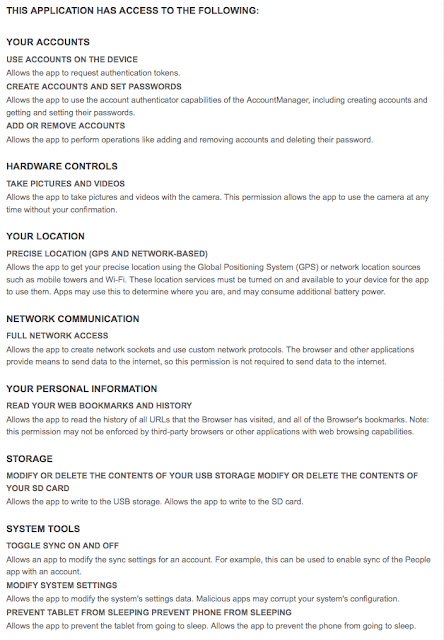
Particularly alarming was what Firefox wanted to do with my tablet's cameras.
 Anybody who installs Firefox gives it permission to take photographs or video [from either camera] whenever it likes. The users permission is not required. Nor are users told when the cameras are operating. Think of the implications of this. Even if users were foolish enough to trust Mozilla [producers of Firefox] what would happen if some malign malware was able to get control of your browser and start the cameras rolling?
How can Mozilla justify including this in Firefox? If it is not spyware it is hard to imagine how else it could be defined. It would be interesting to know what has gone wrong at Mozilla for this to happen.
I didn't download Firefox [though over 200,000 idiots have done]. I took a look at Google's Chrome browser and it does not seem to need to operate my tablet's cameras. These are the permissions it wants. They are not trivial but at least they exclude the permission for rectal probing that Firefox wants
 Now that I have seen what Firefox for Android wants I wonder what the desktop versions of Firefox are up to.
I started using Firefox several years ago because it had far better privacy protections than Safari or Internet Explorer. The desktop version still has.
I recently acquired a new Android tablet and went to Google Play [aka Android App Store] to download Firefox.
Link to Firefox on Google Play
To Google's credit they show what permissions an app takes if you install it [Apple do not]. When you look at some of these lists of permissions it is clear that many of the apps in the Play Store are little better than spyware.
I checked Firefox's permissions but I did not expect to find anything untoward.
The apps description emphasises privacy as you can see below.

However, when you look at the detailed list of the permissions the app would take it is clear that it provides anything but privacy.

Particularly alarming was what Firefox wanted to do with my tablet's cameras.

How can Mozilla justify including this in Firefox? If it is not spyware it is hard to imagine how else it could be defined. It would be interesting to know what has gone wrong at Mozilla for this to happen.
I didn't download Firefox [though over 200,000 idiots have done]. I took a look at Google's Chrome browser and it does not seem to need to operate my tablet's cameras. These are the permissions it wants. They are not trivial but at least they exclude the permission for rectal probing that Firefox wants

An alternative to Google
For the past year I have been using the DuckDuckGo search engine as an alternative to Google.
Don't be put off by the idiotic name, it is a pretty good search engine. It does not have all the services offered by Google. There is no translation and DDG's image search is not as good.
However, it works well for web searching and its privacy policies are much better. Whenever you use Google it collects information about you and uses it to build up a profile which it can sell to advertisers. DDG claims that it does not do that and does not track its users. It also filters out dross from 'content mills'.
"DuckDuckGo's results are a compilation of many sources, including Yahoo! Search BOSS, Wikipedia, Wolfram Alpha and its own Web crawler, the DuckDuckBot.
DuckDuckGo positions itself as a search engine that puts privacy first and as such it does not store IP addresses, does not log user information and uses cookies only when needed. Weinberg states "By default, DuckDuckGo does not collect or share personal information.
Weinberg has refined the quality of his search engine results by deleting search results for companies he believes are content mills, like Demand Media's eHow, which publishes 4000 articles per day produced by paid freelance writers, which Weinberg says is, "...low-quality content designed specifically to rank highly in Google's search index." DuckDuckGo also filters pages with substantial advertising."
Read more about it at
Wikipedia
Washington Post
PCWorld
New York Times
Don't be put off by the idiotic name, it is a pretty good search engine. It does not have all the services offered by Google. There is no translation and DDG's image search is not as good.
However, it works well for web searching and its privacy policies are much better. Whenever you use Google it collects information about you and uses it to build up a profile which it can sell to advertisers. DDG claims that it does not do that and does not track its users. It also filters out dross from 'content mills'.
"DuckDuckGo's results are a compilation of many sources, including Yahoo! Search BOSS, Wikipedia, Wolfram Alpha and its own Web crawler, the DuckDuckBot.
DuckDuckGo positions itself as a search engine that puts privacy first and as such it does not store IP addresses, does not log user information and uses cookies only when needed. Weinberg states "By default, DuckDuckGo does not collect or share personal information.
Weinberg has refined the quality of his search engine results by deleting search results for companies he believes are content mills, like Demand Media's eHow, which publishes 4000 articles per day produced by paid freelance writers, which Weinberg says is, "...low-quality content designed specifically to rank highly in Google's search index." DuckDuckGo also filters pages with substantial advertising."
Read more about it at
Wikipedia
Washington Post
PCWorld
New York Times
The Eternal Value of Privacy
"Cardinal Richelieu understood the value of surveillance when he famously said, 'If one would give me six lines written by the hand of the most honest man, I would find something in them to have him hanged.'
Watch someone long enough, and you'll find something to arrest -- or just blackmail -- with. Privacy is important because without it, surveillance information will be abused: to peep, to sell to marketers and to spy on political enemies -- whoever they happen to be at the time.
Bruce Schneier writes about the importance of privacy and the dangers of a surveillance society.
"For if we are observed in all matters, we are constantly under threat of correction, judgement, criticism, even plagiarism of our own uniqueness. We become children, fettered under watchful eyes, constantly fearful that -- either now or in the uncertain future -- patterns we leave behind will be brought back to implicate us, by whatever authority has now become focused upon our once-private and innocent acts. We lose our individuality, because everything we do is observable and recordable."
Watch someone long enough, and you'll find something to arrest -- or just blackmail -- with. Privacy is important because without it, surveillance information will be abused: to peep, to sell to marketers and to spy on political enemies -- whoever they happen to be at the time.
Bruce Schneier writes about the importance of privacy and the dangers of a surveillance society.
"For if we are observed in all matters, we are constantly under threat of correction, judgement, criticism, even plagiarism of our own uniqueness. We become children, fettered under watchful eyes, constantly fearful that -- either now or in the uncertain future -- patterns we leave behind will be brought back to implicate us, by whatever authority has now become focused upon our once-private and innocent acts. We lose our individuality, because everything we do is observable and recordable."

Policies devised to protect politicians, not us.
Aviation officials have questioned the need for such a strong permanent police presence at airports, suggesting they were there simply "to make the government look tough on terror".
One senior executive said in his experience, the officers were expensive window-dressing.
"When you add the body scanners, the ritual humiliation of old ladies with knitting needles and the farcical air marshals, it all adds up to billions of dollars to prevent what? A politician being called soft on terror, that's what," he said.
From this article.
How many other policies, not just anti terrorist ones, are there to protect politicians from political criticism. In the UK we had a lot during Labours period of office, plus a lot of oppressive new laws.
One senior executive said in his experience, the officers were expensive window-dressing.
"When you add the body scanners, the ritual humiliation of old ladies with knitting needles and the farcical air marshals, it all adds up to billions of dollars to prevent what? A politician being called soft on terror, that's what," he said.
From this article.
How many other policies, not just anti terrorist ones, are there to protect politicians from political criticism. In the UK we had a lot during Labours period of office, plus a lot of oppressive new laws.
Traitorware - the dangers of hidden data
Back in 2007, when geotagged photographs of newly arrived helicopters at a U.S. Army base in Iraq were published to the Internet, they allowed insurgents to determine the exact location of the helicopters inside the compound and conduct a mortar attack. Four of the AH-64 Apaches on the flight line were destroyed in the attack.
Upon opening the Path application on your phone, it automatically uploaded your address book to Path's servers so it could find "friends" that you might want to connect to without asking for explicit permission to do so, or even implicit permission for that matter.
In the U.S., data from grocery store loyalty schemes has been used by security services to search for terrorist suspects. Turns out the number of toilet rolls you buy can be quite telling.
There was an interesting paper recently by Adam Sadilek of the Department of Computer Science at the University of Rochester. It talked about how geotagged tweets could be used to locate individuals, even if they themselves didn't geotag their tweets — it was enough that their friends did so.
From this article.
EFF on traitorware
Upon opening the Path application on your phone, it automatically uploaded your address book to Path's servers so it could find "friends" that you might want to connect to without asking for explicit permission to do so, or even implicit permission for that matter.
In the U.S., data from grocery store loyalty schemes has been used by security services to search for terrorist suspects. Turns out the number of toilet rolls you buy can be quite telling.
There was an interesting paper recently by Adam Sadilek of the Department of Computer Science at the University of Rochester. It talked about how geotagged tweets could be used to locate individuals, even if they themselves didn't geotag their tweets — it was enough that their friends did so.
From this article.
EFF on traitorware
Airport scanner abuse - who would have thought it?

"TSA agents in Dallas singled out female passengers to undergo screening in a body scanner, according to complaints filed by several women who said they felt the screeners intentionally targeted them to view their bodies. One woman who flew out of Dallas-Ft. Worth International Airport several months ago said a female agent sent her through a body scanner three times after the agent commented on her “cute” body.
Terrell said the female agent appeared to be acting on a request from male agents who were in a separate room viewing the scans and who apparently asked the agent to send Terrell back through the scanner twice because the scan was blurry.
After the third scan, Terrell said the agent seemed frustrated with her co-workers in the screening room. “She’s talking into her microphone and she says, ‘Guys, it is not blurry, I’m letting her go,’” Terrell said."
Who would have thought such a thing might happen?
Below is a post of mine from January 2010.
Celebrity Scanner
Since it emerged that the full body scanners now being used in airports can store and transmit images I have been thinking about trying to break into TV with an idea for a new reality show.
I am going to call it 'Celebrity Scanner".
It would show the nude scans of prominent figures [e.g. film and TV stars, female politicians, wives of prominent figures etc.]. As the scans are being broadcast a panel of smartarses would make cruel and witty remarks about the bodies displayed. Audiences would vote on who had the biggest bums, or the most cellulite.
Who has the fattest thighs, Sarah Brown or Harriet Harmon? Text Fatbum to 81400 to vote.
The fun would be enormous.
 There should be plenty of juicy material available.
This article from somebody who has seen the big screen images makes my mouth water -
"The images leave little to the imagination, exposing passengers' bodies in sufficient detail for screeners to count the change in our pockets and see beads of sweat on our backs—not to mention intimate, gender-specific details."
As soon as these scanners come into widespread use there will be a big black market in celebrity scans. It will be easy to Bit Torrent stuff or buy bootleg DVDs.
There might be a bit of resistance to the idea from celebrities, but I will argue that the public has the right to see these images. Why should drooling airport security guards and their customers have all the fun.
There is also scope for programmes on special themes. 'Guess who shaves' is in pre-production planning as I write.
SOPA & PIPA - follow the money
From an article on the BBC website
In part, by spending heaps of cash lobbying the US Congress for legislation to enact laws that would punish repeat copyright offenders and bar US-based internet service providers, payment processors and advertisers from doing business with alleged infringers.
Television, film and recording industry companies and trade associations spent $92m (£60m) on lobbying expenses in 2011, including on the online piracy and copyright protection issues, according to an analysis of lobbying disclosure forms by the Center for Responsive Politics.
The companies and associations employed 596 lobbyists last year."

In what is frequently derided as Washington's revolving door, many lobbyists and industry advocates in Washington are former members of Congress or held roles as congressional staff.
Some of those worked on the very congressional committees they now hope to influence.
For instance, one of the chief lobbyists for the Recording Industry Association of America (RIAA), senior executive vice-president Mitch Glazier, is former chief counsel for intellectual property on the House Judiciary Committee.
That committee is currently debating the Sopa legislation. Its chairman is Sopa's chief sponsor, Republican Lamar Smith of Texas."
"How do the companies go about influencing Congress?
Television, film and recording industry companies and trade associations spent $92m (£60m) on lobbying expenses in 2011, including on the online piracy and copyright protection issues, according to an analysis of lobbying disclosure forms by the Center for Responsive Politics.
The companies and associations employed 596 lobbyists last year."

"Who are the lobbyists, and what do they do?
Some of those worked on the very congressional committees they now hope to influence.
For instance, one of the chief lobbyists for the Recording Industry Association of America (RIAA), senior executive vice-president Mitch Glazier, is former chief counsel for intellectual property on the House Judiciary Committee.
That committee is currently debating the Sopa legislation. Its chairman is Sopa's chief sponsor, Republican Lamar Smith of Texas."
Subscribe to:
Posts (Atom)