On a recent visit to Vancouver I went out to the University of British Columbia [UBC] campus. There is much of interest on the campus, including the Museum of Anthropology, the Nitobe Gardens and the Museum of Biodiversity. See my posts on the first two of these.
This post is about a recently added attraction. The Tallwood student residence. This building is the tallest wooden building in the world with 17 stories and accommodation for 400 students. Instead of using reinforced concrete most of the building is constructed using cross laminated timber [CLT].
CLT is like grown up plywood. It consists of strips of timber glued together to whatever thickness and shape is required. CLT is very strong and rot and fire resistant. Accommodation units were factory built off site and then just slotted into the building.
This video provides a time lapse of the buildings construction.
Using CLT speeds construction and is environmentally superior to concrete. Instead of using a lot of energy to produce cement the CLT building method locks up CO2 for the life of a building.
Canada has a lot of trees and is well equipped to lead in the construction of buildings like Tallwood. The amount of timber used in the construction was replaced in 6 minutes by the normal growth of Canada's forests.
A lot of Canada's cities have housing shortages. The situation in Vancouver is particularly bad. Some government contracts to build a lot of apartment blocks would be a way of developing the country's CLT production and construction industries.
New Zealand is another country with a lot of trees but not enough houses. I wonder if it is looking a CLT construction.
Visiting UBC
There are frequent buses from downtown Vancouver. It is a very attractive campus but also a large one. The Museum of Anthropology [shown as MOA on campus maps] and the Nitobe Gardens are close together on the edge of the campus. Tallwood and the Museum of Biodiversity more central and are fairly close together.
Showing posts with label houses. Show all posts
Craigievar Castle - a Scottish tower house
Craigievar Castle is not a castle but a tower house built in the Scottish Baronial style. Its walls are thick, its windows high off the ground and it has a yett to protect its door; but it was designed to keep criminals out, not armies.
Tower houses are found elsewhere in Scotland, and in other countries. Spain has them. The ones in San Gimignano in Italy are well known. Pavia has some nice ones. There are two right in the centre of Bologna. There is a small one a few miles from my house.
Craigievar is located west of Aberdeen in Scotland, close to the tower houses of Crathes Castle and Castle Fraser.
I have already posted on Crathes and will post on Castle Fraser. The houses are very similar, partly because they were all worked on by the same family of masons. Also, no doubt their owners swapped ideas.
Many consider Craigievar the most romantic of the Scottish tower houses. It is certainly the most striking. Especially since it is now pretty in pink.
| Craigievar is in a very fine situation with views over open countryside |
The castle belongs to the National Trust for Scotland. In the 1970s the castle was covered with a cement harl. That turned out to be a bad idea because cement traps water between the harl and the building, leading to structural and internal damage.
In 2009 the the castle was closed while the cement harl was stripped off and replaced with a lime harl which allows the building to breath. The cement harl had been off white but pigment was added to the lime harl to restore the pink appearance that Craigievar had had in the early 19th century. The castle now looks fabulous.
It costs £11 to join a guided tour of the castle. The only way to move from floor to floor is by a narrow stone staircase. Tower houses are not comfortable places. The castle does not have electric lighting in most of its rooms and the only heating is from open fires. Baths were a late addition. They are not for the old or young because steep stone stairs connect the many floors.
Rather annoyingly, the National Trust does not allow photography within the building.
Ightham Mote - a moated manor house
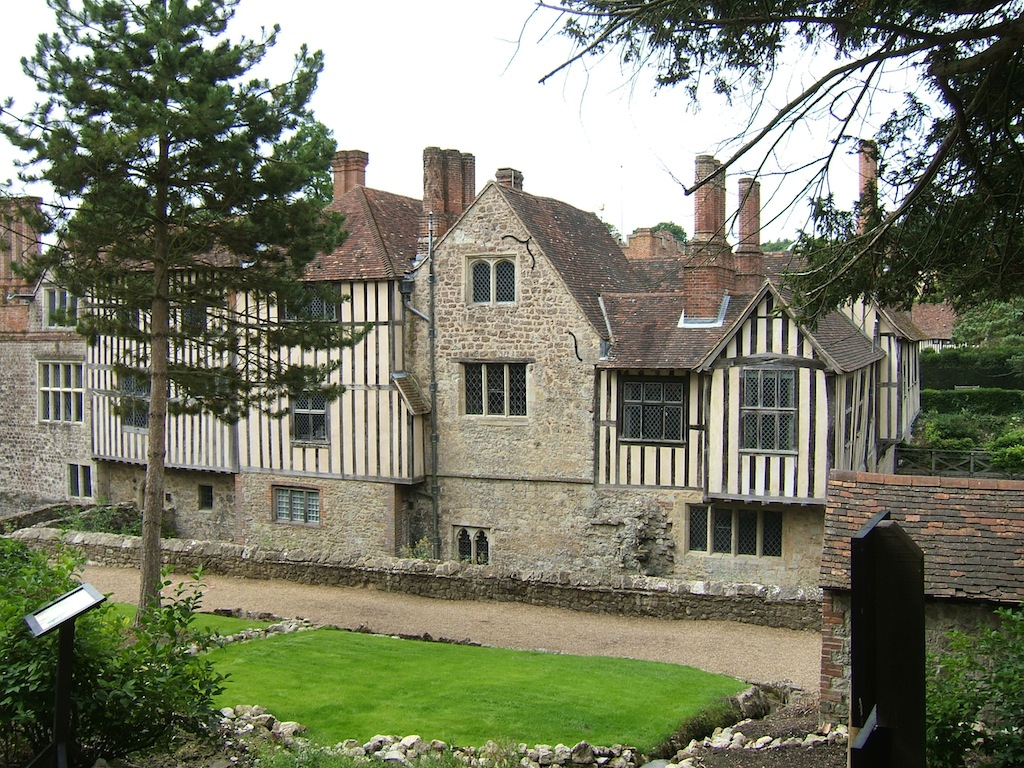
Ightham Mote (pronounced "item moat") is a moated manor house located to the south-east of London. It dates back to 1320 and has been described as "the most complete small medieval manor house in the country [Pevsner]. It is owned by the National Trust and is open to the public.
To the left of the house the former stables and staff quarters have been converted into flats.
The small courtyard. You can see the Grade 1 listed dog kennel to the right. My earlier post on the dog kennel is here.
The house is the work of many hands. For example, the stone part of the tower is thought to date to date to the early 14th century, the stained glass windows to the early 16th century, the brick turret top to the late 19th century and the weathercock to the 1960s.
The sink and draining board are covered in lead to reduce damage to valuable pottery and silverware.
The First World War was particularly heavy on subalterns and the British aristocracy never recovered from its losses.
By the end of the 1980s the house was in poor condition and the National Trust decided on a major restoration. So major that it came close to complete demolition and rebuilding. The NT spent over £10 million rebuilding the house, employing the same building techniques that had been originally employed. There is an exhibition at the house showing what they did and the tools they used. The tools below are for working lead.
I think Britain is fortunate to have an organisation like the NT, which is willing to spend a lot of money to preserve something like Ightham Mote and has the skills needed to do such a good job.
The house has over 70 rooms. Not all of them are open to the public. The ones that are closed are shaded on the plan below. There are more than enough rooms open and furnished to provide a superb experience.
Unlike Harvington Hall and Baddesley Clinton, Ightham Mote does not appear to have any hidden rooms [aka priest's holes]. You can find my post on Harvington Hall here and on Baddesley Clinton here.
It is a beautiful house in a secluded valley. Before modern roads it must have been hard to find and [in winter] hard to reach, despite being so close to London. There is a story that Cromwell's soldiers wanted to loot the place but could not find it, so they looted another house instead.
It has been owned by a number of families. The Hautes, the Selbys [who had it for three centuries], the Colyer-Fergusons and the American general who founded Colorado Springs. None of the British owners played any great part in national affairs.
When the house fell on hard times it was saved by an American called Charles Robinson. He bequeathed it to the National Trust.
To the left of the house the former stables and staff quarters have been converted into flats.
| The Great Hall |
The small courtyard. You can see the Grade 1 listed dog kennel to the right. My earlier post on the dog kennel is here.
The house is the work of many hands. For example, the stone part of the tower is thought to date to date to the early 14th century, the stained glass windows to the early 16th century, the brick turret top to the late 19th century and the weathercock to the 1960s.
The house's valuable silver was kept in a safe in the butlers pantry.
The sink and draining board are covered in lead to reduce damage to valuable pottery and silverware.
| The private chapel |
The First World War was particularly heavy on subalterns and the British aristocracy never recovered from its losses.
| The housekeepers room |
I think Britain is fortunate to have an organisation like the NT, which is willing to spend a lot of money to preserve something like Ightham Mote and has the skills needed to do such a good job.
The house has over 70 rooms. Not all of them are open to the public. The ones that are closed are shaded on the plan below. There are more than enough rooms open and furnished to provide a superb experience.
Unlike Harvington Hall and Baddesley Clinton, Ightham Mote does not appear to have any hidden rooms [aka priest's holes]. You can find my post on Harvington Hall here and on Baddesley Clinton here.
This is my third post on Ightham Mote. My post on its giant dog kennel is here and a post on its porters squint is here.
Baddesley Clinton - a moated manor house
Baddesley Clinton is an medieval moated manor house just to the south east of Birmingham in the United Kingdom. The Baddesley part of the name comes from a Saxon called Baeddi who cleared the site in the Forest of Arden. The Clinton part comes from the Clinton family who dug the moat in the 13th century.
For 500 years the manor house was the home of the Ferrars family. If that seems a long time for one family to own a house consider that Country Life magazine estimated that there were still over 1500 houses and estates in England that had been owned by the same family for over 500 years.
The house is now owned by the National Trust and is open to the public.
Visitors to Baddesley Clinton cross the bridge, go through the gatehouse and come to a central courtyard with buildings on three sides. In many such houses there are buildings on all four sides but Baddesley Clinton is unusual.
One side of the courtyard is open. There might have been a great hall on this side at one point but now there is a garden.
Baddesley Clinton has three priest holes. These are concealed places where Catholic priests and their adherents could hide if the house was raided by government agents [the government was persecuting Catholics at the time the holes were created and priests faced torture and execution].
Two of the holes are covered up and cannot be seen. The trapdoor below is the entrance to the third, a disused sewer at the rear of the house. Several people hid in this hole for four hours when the house was raided.
If you want to see priest holes you should visit Harvington Hall. That manor house has more priest holes than any in England. It is only 25 miles away. Harvington Hall is to the south west of Birmingham and BC is to the south east of the city. You could also read my post on Harvington Hall.
The National Trust has done a superb job of furnishing the interior. Some of the furniture belonging to the house was sold during hard times so the Trust has brought in items from other houses, or donations it has received.
The photograph below shows the library.
The house has some superb stained glass.
For 500 years the manor house was the home of the Ferrars family. If that seems a long time for one family to own a house consider that Country Life magazine estimated that there were still over 1500 houses and estates in England that had been owned by the same family for over 500 years.
The house is now owned by the National Trust and is open to the public.
Visitors to Baddesley Clinton cross the bridge, go through the gatehouse and come to a central courtyard with buildings on three sides. In many such houses there are buildings on all four sides but Baddesley Clinton is unusual.
One side of the courtyard is open. There might have been a great hall on this side at one point but now there is a garden.
Baddesley Clinton has had many owners who have extended or changed the house. Most of the façade is stone, but as you can see above, there is one side faced in brick. Some of the history of the house can be read in its structure.
Baddesley Clinton has three priest holes. These are concealed places where Catholic priests and their adherents could hide if the house was raided by government agents [the government was persecuting Catholics at the time the holes were created and priests faced torture and execution].
Two of the holes are covered up and cannot be seen. The trapdoor below is the entrance to the third, a disused sewer at the rear of the house. Several people hid in this hole for four hours when the house was raided.
If you want to see priest holes you should visit Harvington Hall. That manor house has more priest holes than any in England. It is only 25 miles away. Harvington Hall is to the south west of Birmingham and BC is to the south east of the city. You could also read my post on Harvington Hall.
The National Trust has done a superb job of furnishing the interior. Some of the furniture belonging to the house was sold during hard times so the Trust has brought in items from other houses, or donations it has received.
The photograph below shows the library.
The house has some superb stained glass.
Other moated manor houses
See my posts on Ightham Mote and Harvington Hall
Dean Village, Edinburgh
Dean Village is one of the most attractive parts of Edinburgh. It is a ten minute walk up Queensferry Street from the west end of Princes Street in central Edinburgh.
Several centuries ago the Water of Leith was dammed and water powered flour mills set up in the village. At one point there were 11 mills.
Now the former mills and workers tenements have been very attractively restored to provide housing.
Telford's magnificent 106 feet high bridge is just down river from the village and the Water of Leith Walkway passes the village. It is a 3.5 mile walk along the walkway from Dean Village to Leith. The Dean Gallery and the Gallery of Modern Art are close to the village.
The area has now become an attractive place to live.
This flat was recently for sale.
The flat is rather small has only one double bedroom and one single bedroom/box room but it went on sale at offers over £265,000
Several centuries ago the Water of Leith was dammed and water powered flour mills set up in the village. At one point there were 11 mills.
Now the former mills and workers tenements have been very attractively restored to provide housing.
Telford's magnificent 106 feet high bridge is just down river from the village and the Water of Leith Walkway passes the village. It is a 3.5 mile walk along the walkway from Dean Village to Leith. The Dean Gallery and the Gallery of Modern Art are close to the village.
The area has now become an attractive place to live.
This flat was recently for sale.
The flat is rather small has only one double bedroom and one single bedroom/box room but it went on sale at offers over £265,000
Bergheim haut Rhin
There are many half timbered houses in Germany. Not in the cities. They were burned in the WW2 air raids, but in small towns and villages. I have a post on Quedlinberg & Goslar in the north. Amusing Planet has a recent post on Freudenberg. In Bavaria there are towns like Nördlingen, Dinkelsbühl and Rothenburg ob der Tauber on the Romantic Road. Some of these towns still have all or part of their walls still intact. Germany promotes these towns. There is even a German Timber-Frame Road that runs almost 3,000 km and passes through dozens of half timbered towns.
Bergheim haut Rhin is typical of such towns. Lots of well maintained half timbered houses and very clean and tidy.
It looks very touristy but it is not. The town is on a wine trail and there are several places selling local wines but otherwise there are very few places designed just for tourists. Many places have been ruined by a profusion of tourist traps. Especially in France. For example, Carcassonne, Mont Saint-Michel and Provins. The Germans are more careful.
The most curious thing about this very German town is that it is not in Germany. It is currently in France. I say currently because it is in a region that has changed hands frequently.
Though it is in France I suspect most of the inhabitants are of German descent. Not only because of the very un-French way in which they look after their town. When I looked at the WW1 memorial all the names on it were German.
We also called in Saint-Hippolyte which is only a few miles away and very different. It was an unpleasant place with traffic roaring through it all the time we were there.
Bergheim haut Rhin is typical of such towns. Lots of well maintained half timbered houses and very clean and tidy.
It looks very touristy but it is not. The town is on a wine trail and there are several places selling local wines but otherwise there are very few places designed just for tourists. Many places have been ruined by a profusion of tourist traps. Especially in France. For example, Carcassonne, Mont Saint-Michel and Provins. The Germans are more careful.
| Bergheim still has most of its walls |
| The backs of some of the half timbered houses |
The most curious thing about this very German town is that it is not in Germany. It is currently in France. I say currently because it is in a region that has changed hands frequently.
Though it is in France I suspect most of the inhabitants are of German descent. Not only because of the very un-French way in which they look after their town. When I looked at the WW1 memorial all the names on it were German.
We also called in Saint-Hippolyte which is only a few miles away and very different. It was an unpleasant place with traffic roaring through it all the time we were there.
Harvington Hall - a moated manor house
Harvington Hall is a 16th century moated manor house located south-east of Kidderminster in England. It was built in the 1580s, at one point was left derelict, and is now owned by the Roman Catholic Church.
It is open to the public. The visitors fee is £5. You can go around on your own or join a tour led by a volunteer. It is well worth joining a tour. Mine was very interesting and informative.
As you can see from the photograph it is a very attractive building with its red brick and sandstone.
Harvington Hall is known for having more priest holes than any house in England. A priest hole is a hiding places for priests built into many of the principal Catholic houses of England during the period when Catholics were persecuted by law in England. This persecution started early in the reign of Queen Elizabeth I in 1558.
Nicholas Owen, who was the leading builder of priest holes, must have spent a long time at Harvington Hall.
Whoever built them displayed a sound knowledge of practical psychology. For example, this one was underneath a corridor. If the trapdoor had been put in a room there would have been the danger that someone sitting in the room might might notice some anomaly and investigated, but nobody lingers in a corridor.
This one was under some stairs. If somebody lifted the stairs they would find a jewellry store. Greed might then lead them to steal the jewellery and forget to investigate further and find the priest hole beyond.
However, it tilts up to reveal a priest hole. This hole was so well hidden that it was only discovered in the 20th century by some children who were playing.
My favourite was this one. The priest hole is in the ceiling of a room and to get to it you have to climb up this chimney.
It would have been interesting to see more on the history of the house and how it was restored. There could also have been more on Elizabeth's persecution of the Catholics that created the need for the priest holes.
Harvington Hall is well worth a visit.
It is open to the public. The visitors fee is £5. You can go around on your own or join a tour led by a volunteer. It is well worth joining a tour. Mine was very interesting and informative.
As you can see from the photograph it is a very attractive building with its red brick and sandstone.
Nicholas Owen, who was the leading builder of priest holes, must have spent a long time at Harvington Hall.
Whoever built them displayed a sound knowledge of practical psychology. For example, this one was underneath a corridor. If the trapdoor had been put in a room there would have been the danger that someone sitting in the room might might notice some anomaly and investigated, but nobody lingers in a corridor.
The piece of wood on the left just looks like a supporting timber.
However, it tilts up to reveal a priest hole. This hole was so well hidden that it was only discovered in the 20th century by some children who were playing.
My favourite was this one. The priest hole is in the ceiling of a room and to get to it you have to climb up this chimney.
It would have been interesting to see more on the history of the house and how it was restored. There could also have been more on Elizabeth's persecution of the Catholics that created the need for the priest holes.
Harvington Hall is well worth a visit.
Other moated manor houses
See my posts on Ightham Mote and Baddesley Clinton [Baddesley Clinton is about 20 miles to the east of Harvington Hall. The house is under the care of the National Trust.]
Subscribe to:
Posts (Atom)